




The Pinned Message: The Standard Model
For decades, our understanding of cosmic history was relatively neat. It was all governed by the Standard Model of Cosmology, a sort of 'pinned message' at the top of the group chat. This model, built on Einstein's theory of relativity, successfully explained
the universe's expansion from a hot, dense state—the Big Bang. It laid out a clear timeline: the universe began, it expanded and cooled, matter formed, and eventually, stars and galaxies lit up the darkness. The discovery of the cosmic microwave background (CMB), the faint afterglow of the Big Bang, seemed to confirm this story perfectly. It was the group chat's foundational text, the 'read-this-first' post that everyone agreed on. All new observations were expected to fit neatly into this established narrative.
New User Joined: The James Webb Space Telescope
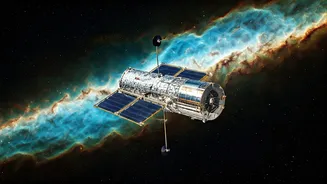
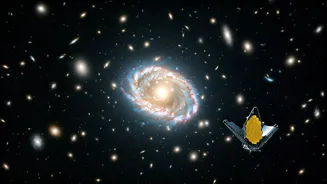
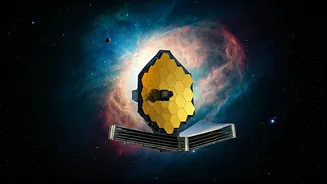
Then, in 2022, a powerful new user joined the chat: the James Webb Space Telescope (JWST). Almost immediately, it started posting pictures that made everyone scroll back up in confusion. JWST began spotting galaxies in the very early universe that were far brighter and more massive than the Standard Model predicted should be possible. According to the old timeline, these galaxies were 'impossibly' mature, like seeing a fully grown adult in a photo of the universe's nursery. These discoveries have been likened to finding a toddler who can bench-press a car. Were our models of galaxy formation wrong? While some explanations suggest early galaxies were just much brighter and more efficient at making stars due to active black holes at their centers, the sheer number of these mature-looking structures has sent cosmologists scrambling. The new user was spamming the chat with evidence that the old rules might not apply.
Someone is Typing... in Spacetime Ripples
At the same time, another kind of message has been arriving, not through light, but through tremors in spacetime itself. The detection of gravitational waves, first confirmed in 2015, opened a new channel of communication. These ripples, caused by cataclysmic events like the merger of two black holes, carry unaltered information from the moment they were created. They are like audio messages from the universe's most violent moments, offering a completely different kind of history. Some theories even suggest that gravitational waves from the Big Bang itself could have shaped the universe's early structure, potentially explaining how those first galaxies formed so quickly. This new source of information allows us to 'listen' to parts of cosmic history that were previously invisible, adding another layer of chaotic but exciting conversation to the group.
The @All Notification: The Hubble Tension
Perhaps the most frantic argument in the group chat is the 'Hubble Tension'. This is a major disagreement about how fast the universe is expanding. It’s like two of the most trusted admins giving completely different answers to the same question. One method, which studies the early universe (the CMB), gives a lower expansion rate of about 67 km/s/Mpc. The other method, which looks at the nearby, modern universe using objects like supernovae, gives a higher rate of about 73 km/s/Mpc. The difference might seem small, but it's a massive problem that has been called a 'crisis in cosmology'. As measurements have gotten more precise, the disagreement has only grown stronger, suggesting it's not just a simple error. This tension implies that something fundamental in our Standard Model—our pinned message—is either wrong or incomplete.
What The Admins Are Saying Now
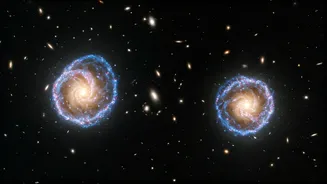
So, how are scientists—the chat admins—coping with this delightful chaos? They're doing what scientists do best: proposing new ideas. Some are re-evaluating theories of star and galaxy formation. Others are looking for 'new physics', perhaps an unknown particle or force that could resolve the Hubble Tension or explain the universe's bizarrely large structures, like the recently discovered 'Big Ring', a circle of galaxies so vast it shouldn't exist according to the Standard Model. Even stranger ideas are on the table, such as the possibility that dark matter and neutrinos interact in ways we never expected, which could affect how galaxies cluster together. No one is deleting the old messages, but everyone is busy trying to edit the timeline to accommodate the flood of new, contradictory information. It's a messy, confusing, and thrilling time to be in the chat.