




What Are Perovskite Solar Cells?
Imagine a solar material that is not only highly efficient but also potentially cheaper and simpler to produce. That is the promise of perovskites. Unlike conventional solar panels, which are made from rigid, heavy silicon wafers, perovskite solar cells
use a special crystal structure. These materials can be processed into a kind of 'solar ink' and printed onto surfaces, making them lightweight, flexible, and versatile. This manufacturing process is less energy-intensive than that for silicon, which requires very high temperatures. This combination of high efficiency and lower production cost is why scientists and energy companies are so excited about their potential to revolutionise the solar industry.
A Leap in Efficiency
The progress in perovskite efficiency has been astonishing. While it took decades for traditional silicon cells to reach their current levels, perovskites have made similar gains in just over ten years. Lab results for perovskite-silicon 'tandem' cells, which stack a perovskite layer on top of a silicon one, have already surpassed 34% efficiency. This tandem structure is particularly effective because each layer captures a different part of the light spectrum. The perovskite top layer absorbs high-energy blue and green light, while the silicon bottom layer captures the red and infrared light that passes through. This allows the cell to convert more of the sun's energy into electricity than either material could on its own, breaking through the theoretical efficiency limits of silicon-only cells.
The Link Between Efficiency and Cost
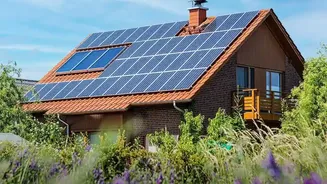
Higher efficiency directly translates to lower costs for homeowners. A more efficient panel generates more power from the same amount of space. This is crucial for homes with limited roof area, where maximising energy production is key. If you can generate the same amount of electricity with fewer panels, your upfront costs for materials and installation decrease. Furthermore, many of the 'soft costs' of a solar installation—like design, permitting, and labour—don't change much whether you are installing a standard panel or a high-efficiency one. By getting more watts per panel, the overall cost per watt of the entire system drops, making the economics of going solar more attractive even if the panels themselves are initially priced at a premium.
Challenges on the Road to Your Rooftop
Despite the record-breaking performance in labs, perovskite solar cells are not on most rooftops yet. The biggest hurdle is durability. Early versions of these cells have shown vulnerability to moisture, heat, and even prolonged exposure to light, causing them to degrade much faster than the 25- to 30-year lifespan expected from silicon panels. Researchers are actively working on solutions, such as developing protective encapsulation techniques and tweaking the chemical composition of the perovskite material to make it more robust. Proving long-term stability in real-world conditions is the final frontier before mass commercialisation can begin.
When Can We Expect Them in India?
The race to bring perovskite solar panels to market is well underway, with initial commercial production lines already starting up. While some companies have begun shipping panels for utility-scale projects, widespread availability for residential homes is estimated to be a few years away, realistically between 2027 and 2030. For the Indian market, this technology holds immense promise. Given India's ambitious renewable energy targets and the growing demand for affordable power, a locally manufactured, low-cost, high-efficiency solar solution could be a game-changer. It could accelerate the adoption of rooftop solar in both dense urban areas with limited space and rural communities seeking energy independence. As manufacturing scales up and durability is proven, perovskites could play a pivotal role in shaping India's energy future.