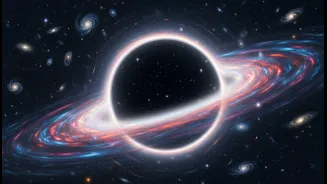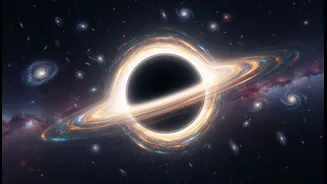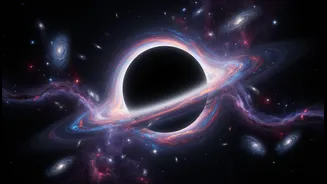



A Cosmic Conundrum
Imagine trying to explain how a newborn baby grew to the size of a mountain in just a few minutes. That’s the cosmic equivalent of the puzzle facing astronomers today. Using powerful tools like the James Webb Space Telescope (JWST), scientists are peering
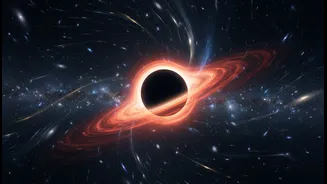
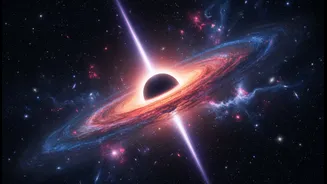
back to the dawn of time, less than a billion years after the Big Bang. And they are finding monsters: black holes that are millions or even billions of times the mass of our sun. According to the long-held standard model, this shouldn't be possible. The universe simply wasn’t old enough for them to have grown that large through the conventional, slower process.
The Old Story: 'Light Seeds'
The traditional theory of supermassive black hole formation is a story of slow and steady growth. It begins with what are known as “light seeds.” The idea is that the very first generation of massive stars in the universe, after living short and brilliant lives, collapsed under their own gravity to form black holes of maybe 10 to a few hundred times the mass of the sun. These modest seeds would then begin to feed on the surrounding gas, dust, and stars, gradually packing on weight. Over billions of years, through a constant process of feeding and merging with other black holes, they would eventually swell into the supermassive giants we see at the centre of most large galaxies today, including our own Milky Way.
A Glitch in the Cosmic Timeline
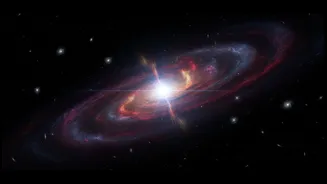
The problem is that recent discoveries, many from the JWST and the Euclid space telescope, are showing us black holes that are already enormous at a very early stage of the universe's history. Some of these objects existed just 500 to 700 million years after the Big Bang, yet they defy the conventional growth timeline. One such object, part of a class of mysterious objects nicknamed “Little Red Dots,” was found to host a black hole that is far more massive than its host galaxy would suggest it should be. This finding directly challenges the idea that black holes and their galaxies grow in tandem. If the black hole grew faster than its galaxy, it breaks the 'light seed' model. There just wasn't enough time.
Enter the 'Heavy Seeds'
This cosmic timing problem has given a major boost to an alternative, once-fringe theory: the concept of “heavy seeds.” Instead of starting small, what if some black holes were simply born big? The heavy seed model proposes that under the unique, pristine conditions of the very early universe, vast clouds of gas could have collapsed directly into a black hole, bypassing the star-formation stage entirely. This “direct collapse” could create a starting seed black hole that was already tens of thousands, or even hundreds of thousands, of times the mass of the sun. Starting with such a massive advantage would make it much easier to explain the behemoths we now see in the cosmic dawn.
Rewriting the First Chapter
The growing evidence for heavy seeds represents a potential paradigm shift in our understanding of the universe's first billion years. It doesn't just change the story of black holes; it changes the story of galaxies. The standard model assumed galaxies formed first, creating the stars that would later become black hole seeds. But if massive black holes could form directly, it raises a tantalizing possibility: perhaps the black holes came first, acting as gravitational anchors around which the first galaxies then began to form. Discoveries from the JWST suggest some of these early, oversized black holes exist with barely a host galaxy to speak of, lending weight to this revolutionary new idea.