
A Universe of Unknowns
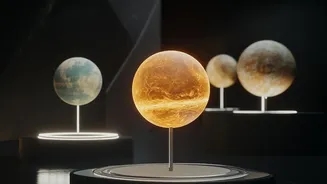
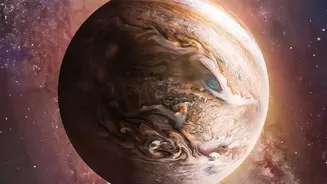
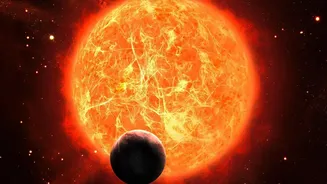
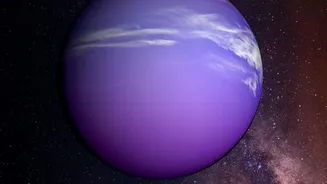
Since the first confirmed discoveries in the 1990s, the catalogue of planets orbiting other stars has grown exponentially. These distant worlds are incredibly diverse, from massive gas giants orbiting perilously close to their stars to small, rocky planets that
could, in theory, be like our own. The challenge, however, is immense. The nearest exoplanet is more than four light-years away, making direct travel impossible with current technology. Astronomers must therefore rely on clever, indirect methods to study them. By observing the faint dip in a star's light as a planet passes in front of it—a technique called transit spectroscopy—they can begin to decode the composition of that planet's atmosphere. But this data is just a collection of light signatures; interpreting what it means requires a reliable guide.
The Perfect Blueprint
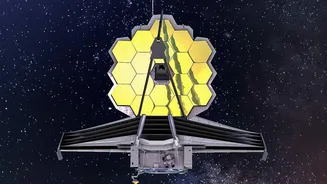
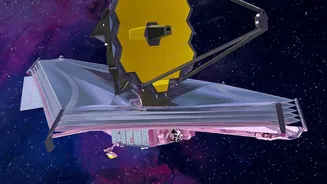
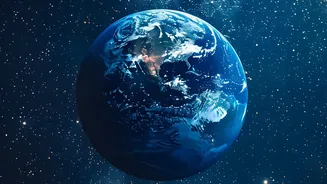
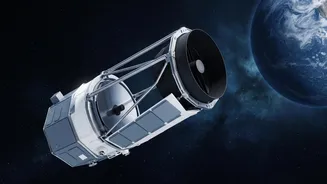
This is where our own planet becomes the most valuable tool in an astronomer's kit. Earth is the only world we know of that definitively harbours life, making it the ultimate benchmark for habitability. It provides a ground truth—a complex, living example against which all theories and models can be tested. Scientists use Earth as what they call an 'exoplanet analogue'. They study its geology, atmosphere, oceans, and the chemical fingerprints of its biosphere to understand what a living planet looks like from afar. This allows them to create templates for what to look for when powerful instruments like the James Webb Space Telescope (JWST) are pointed at distant star systems.
Studying Earth From Afar
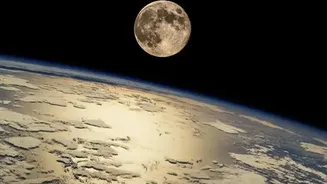
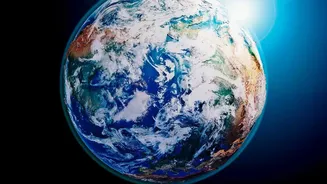
To truly use Earth as a reference, scientists have to observe it as if it were an exoplanet. This involves looking at the light reflected and emitted by our planet from a great distance, treating it as a single, unresolved point of light. Spacecraft have been used to capture this 'Earth as a dot' data, allowing researchers to see what our planet's composite light signature looks like. These observations reveal key information, such as the presence of water, clouds, and continents. This process helps scientists validate their models and refine their techniques, ensuring that when they detect similar signals from a planet dozens of light-years away, they have a better chance of interpreting them correctly. It is a crucial dress rehearsal for one of science's greatest challenges.
The Search for Telltale Signs
The ultimate goal for many exoplanet scientists is to find 'biosignatures'—gases or combinations of gases in an atmosphere that strongly indicate the presence of life. On modern Earth, the most prominent biosignature is the abundant oxygen produced by photosynthesis, along with its byproduct, ozone, and the presence of methane. Finding oxygen and methane together in an exoplanet's atmosphere would be a monumental discovery, as these gases tend to destroy each other and their coexistence suggests something is constantly replenishing them, quite possibly a biological process. However, scientists are cautious, as geological or chemical processes could potentially mimic these signatures. Earth's own history provides a valuable lesson, showing that for billions of years, life existed without producing large amounts of oxygen, instead possibly creating methane as a primary biosignature.
Our Evolving Guide
Using Earth as a single reference point isn't without its limitations. It's a sample size of one, which could bias our search. Life on other worlds may not follow the same chemical path it did here. To address this, scientists don't just study modern Earth; they model our planet's past. By recreating the atmospheres of different geological eras—from a prebiotic world shrouded in carbon dioxide to an oxygen-poor planet teeming with microbial life—they can create a wider range of templates for what a 'living' planet might look like. This acknowledges that a habitable planet is not a static object but an evolving system. The anoxic Earth of 3.5 billion years ago, for example, is a completely alien world by today's standards, yet it was very much alive. This approach helps broaden the search and reduces the risk of overlooking life simply because it doesn't look exactly like it does on Earth today.