




Sailing on Sunbeams
The concept behind solar sailing sounds almost poetic, but it’s grounded in fundamental physics. Sunlight is made of particles called photons. While individually massless, they carry momentum. When a photon strikes a reflective surface and bounces off,
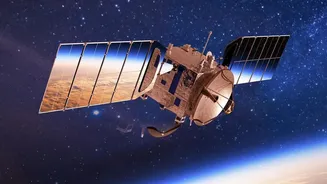
it transfers a tiny amount of that momentum, creating a minute push. Over time, in the frictionless vacuum of space, this constant, gentle pressure can accelerate a spacecraft to tremendous speeds. This method of propulsion is completely passive, requiring no heavy fuel or complex engines. Much like a sailboat angling its sails to catch the wind, a solar sail spacecraft can adjust its orientation to the sun to steer and navigate through the solar system. This eliminates the need for propellant, which is often the single biggest limiting factor in the duration and range of a deep space mission. By shedding the weight of fuel tanks, these probes can be incredibly small and light, opening up new possibilities for low-cost exploration.
The Breakthrough in the Making
The recent excitement isn't from a single discovery, but a convergence of technological advancements that are finally making solar sails a practical tool for deep space. The first major leap is in materials science. NASA's Advanced Composite Solar Sail System (ACS3) mission is testing new booms—the spars that stretch the sail—made of advanced composite materials. These booms are not only 75% lighter than previous metal versions but are also far more resistant to warping from extreme temperature changes in space. The sail itself is an ultra-thin, highly reflective polymer coated in aluminum, thinner than a human hair and capable of being packed into a tiny volume. This pairs with another breakthrough: miniaturization. Engineers can now pack a fully functional interplanetary spacecraft, complete with cameras and communication systems, into a vessel the size of a shoebox, known as a CubeSat. This combination of durable, lightweight structures and compact, capable electronics is what truly unlocks the potential for these ambitious missions.
Chasing the Smallest Worlds
The primary target for this new class of probe is near-Earth asteroids (NEAs). These small celestial bodies are scientific treasures, holding clues to the formation of our solar system. NASA’s NEA Scout mission, launched in 2022, was a prime example of this concept. The shoebox-sized craft was designed to unfurl a solar sail the size of a racquetball court and embark on a two-year journey to visit 2020 GE, an asteroid smaller than a school bus. Such a long, complex trajectory would be nearly impossible for a tiny probe using conventional fuel. While NASA unfortunately lost contact with NEA Scout after its deployment, the mission plan itself demonstrated the immense capability of solar sails. They allow for low-cost reconnaissance missions that can scout asteroids for future robotic or even human exploration, gathering crucial data on their size, shape, and composition long before a larger, more expensive mission is sent. This scouting role is vital for both scientific discovery and planetary defense.
A Future Without Fuel Tanks
Exploring nearby asteroids is just the beginning. The success of these foundational technologies is giving scientists the confidence to dream bigger. Future concepts include the Solar Cruiser, a technology demonstration mission planned for 2025 that will feature a sail nearly 1,700 square meters in size—about four basketball courts—to travel closer to the sun and improve space weather forecasting. At the other end of the scale, researchers are developing concepts like the Berkeley Low-cost Interplanetary Solar Sail (BLISS), which envisions sending swarms of 10-gram micro-probes across the solar system to visit thousands of targets. Looking further out, advanced solar sails could drastically cut travel times, potentially reaching the outer planets in months instead of many years. Some concepts even propose using the intense sunlight near the sun to perform a slingshot maneuver, accelerating probes to a fraction of the speed of light for interstellar journeys. These fuel-free ships promise a more sustainable and expansive future for space exploration.