



Cosmic Fingerprints in Starlight
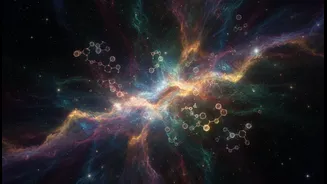
Astrochemistry is the field dedicated to understanding the chemical processes that unfold across the cosmos. Scientists can't simply bottle a distant gas cloud and analyze it. Instead, they act as cosmic detectives, studying the light that travels from
and through these clouds. Every molecule absorbs and emits light at specific, unique wavelengths, creating a 'fingerprint'. By using powerful tools like the James Webb Space Telescope (JWST) and the Atacama Large Millimeter/submillimeter Array (ALMA), astronomers can spot these chemical signatures from light-years away. This allows them to identify which molecules are present, from simple ones like water and methane to surprisingly complex organic compounds.
From the Big Bang to Molecular Clouds
The universe's chemical story began simply. Shortly after the Big Bang, the cosmos consisted almost entirely of hydrogen and helium. The very first molecules to form were incredibly basic. Over billions of years, stars have served as cosmic factories, forging heavier elements through nuclear fusion and scattering them into space when they die. This enriched material gathers into vast, cold nurseries known as molecular clouds. Within these clouds, on the surfaces of frigid dust grains, a slow and intricate chemistry takes place, building larger and more complex molecules. These are the very regions where new stars and planets are born, inheriting the local chemical inventory.
Finding the Ingredients for Life
One of the most profound discoveries in recent years has been the detection of complex organic molecules (COMs) in these star-forming regions. These are carbon-based molecules that are considered precursors to the building blocks of life. For instance, astronomers have recently confirmed the presence of compounds like ethanol, acetic acid (the acid in vinegar), and even simple sugars like erythrulose floating in molecular clouds near the center of our galaxy. The discovery of a sugar in interstellar space for the first time is significant because it shows that key ingredients for life can form naturally long before planets even exist. These molecules can then be incorporated into asteroids and comets, which later deliver them to young, forming planets—potentially seeding them with the raw materials for biology to begin.
A Timeline Written in Molecules
By studying the types and abundance of molecules in different cosmic environments, scientists can piece together a timeline of chemical evolution. The molecular makeup of a dark, cold cloud is different from that of a disc of material actively forming planets around a young star. Recent discoveries are challenging old assumptions. For example, some large and complex molecules are being found in greater abundances than theories predicted, suggesting that the universe is more efficient at building them than we thought. The detection of a large, sulfur-bearing ring molecule closed a critical gap between the simple chemistry seen in space and the complex organics found in meteorites, proving that the chemical groundwork for life begins even before stars are born. These findings help us understand not just our own origins, but also the potential for life to arise in countless other star systems across the galaxy and beyond.