



The Red Planet's Perfect Storm
Martian dust is finer than sand and electrostatically charged, meaning it clings to everything. While the planet's atmosphere is much thinner than Earth's, its winds can still whip this dust into localised storms. Sometimes, these storms merge and grow,
creating regional and even planet-encircling events that can last for weeks. The primary danger for solar-powered explorers like the Spirit and Opportunity rovers isn't the wind, but the darkness. As dust fills the atmosphere, it blocks sunlight from reaching the surface, starving solar panels of the energy needed to operate and, crucially, to power the heaters that protect vital electronics from the extreme Martian cold. This is what ultimately ended the mission for the long-lived Opportunity rover in 2018. After a planet-wide storm blotted out the sun, the rover could no longer recharge its batteries and fell silent forever.
An Eye in the Sky
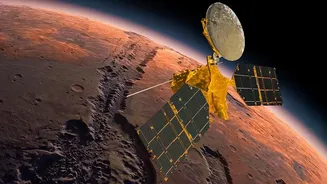
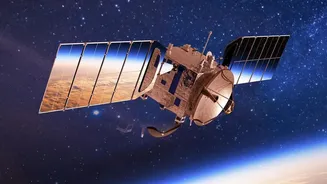
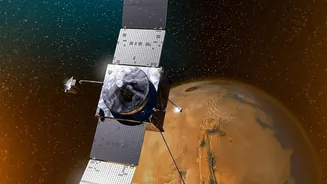
The first line of defence isn't on the ground, but in orbit. A fleet of spacecraft, most notably NASA's Mars Reconnaissance Orbiter (MRO), acts as a planetary weather service. The MRO is equipped with a special wide-angle camera called the Mars Color Imager, or MARCI. Each day, MARCI captures a series of images in multiple visible and ultraviolet wavelengths as it orbits Mars, piecing them together to create a daily global weather map. This allows scientists on Earth to spot dust storms as they begin to form and track their movement and growth across the planet. By monitoring how these storms evolve, the team can forecast their potential threat to assets on the ground. It was the MRO that first spotted the storm that would eventually end Opportunity's mission, giving the rover's team an early warning.
From Orbit to Rover Command
Once a threatening storm is identified, a race against time begins. Data from the MRO and other orbiters like Odyssey and MAVEN is relayed back to Earth. At NASA's Jet Propulsion Laboratory, scientists analyze the storm's trajectory, size, and opacity—a measure of how much sunlight is being blocked. They use this data to predict when the storm will reach a rover and how severe its impact will be. This information is critical for the rover operators, who must then decide on a course of action. The orbiters serve a dual purpose, not only collecting weather data but also acting as the essential communication relay between the rovers on the surface and their human operators back on Earth.
The Survival Playbook
When a severe dust storm is imminent, the primary goal is survival. Mission controllers send commands to the threatened rover to prepare it for the difficult days ahead. All non-essential science activities are suspended to conserve as much energy as possible. The rover is commanded to enter a low-power hibernation state, essentially sleeping through the storm with only its master clock and critical heaters running. This reduces its daily energy consumption to a bare minimum. Engineers hope that the rover's batteries have enough charge to outlast the period of darkness. In the past, they have also hoped for a bit of luck—that seasonal winds, sometimes called 'cleaning events', might blow the accumulated dust off the solar panels after the storm passes, as has happened on previous occasions.
A Nuclear-Powered Future
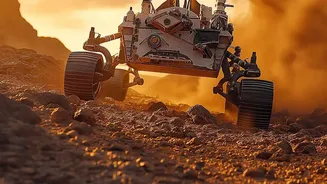
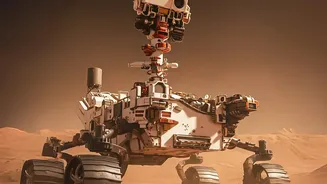
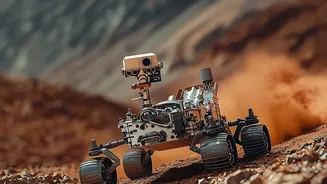
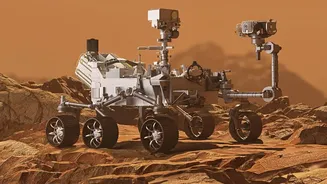
The tragic end of the Opportunity mission highlighted the fundamental vulnerability of relying on solar power in such a dusty environment. Learning from this, NASA's more recent rovers, Curiosity and Perseverance, were designed differently. Instead of solar panels, they are powered by a Radioisotope Thermoelectric Generator (RTG). This device, essentially a nuclear battery, uses the heat generated from the natural decay of plutonium to create electricity. While dust can still reduce visibility for cameras and coat surfaces, it poses no threat to the rovers' ability to generate power. This makes them largely immune to the life-or-death struggles that defined the missions of their solar-powered predecessors, allowing them to continue operating and even study the atmospheric effects of the storms.