



A 'First Light' Moment for Interplanetary Internet
In a remarkable demonstration, NASA's Deep Space Optical Communications (DSOC) experiment successfully beamed an ultra-high-definition video from the Psyche spacecraft back to Earth. The 15-second clip, featuring a cat named Taters, traveled nearly 19
million miles (31 million kilometers) to reach us. This wasn't just a long-distance call; it was a high-speed one. The data was transmitted at a maximum rate of 267 megabits per second (Mbps), a speed comparable to many home broadband connections. The experiment, which launched in October 2023, is designed to prove that laser communications can offer 10 to 100 times the bandwidth of the state-of-the-art radio frequency systems currently used by spacecraft. This achievement marks a critical milestone in developing the capacity for high-volume data transmission from missions far beyond Earth's orbit.
Upgrading from Radio Waves to Laser Beams
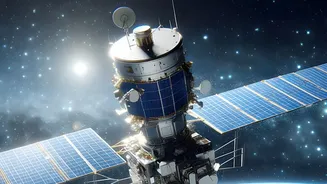
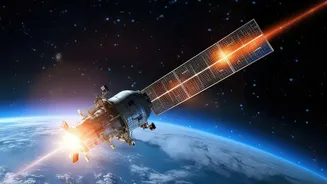
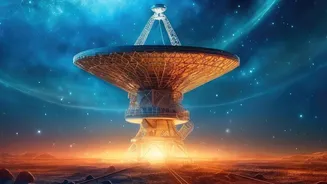
For decades, space communication has relied on radio waves. While reliable, this technology is reaching its limits as our ambitions in space grow. Future missions, especially those involving human crews on Mars, will need to send and receive massive amounts of data, from high-definition video feeds to complex scientific readings. Think of it as upgrading from old telephone lines to modern fiber optics. Laser communications, also known as optical communications, use near-infrared light to encode and transmit information. This technology packs data into much tighter waves, allowing for significantly higher data rates. The DSOC system consists of a flight laser transceiver mounted on the Psyche spacecraft, a powerful uplink laser transmitter on the ground in California, and a sophisticated receiver at Caltech's Palomar Observatory to capture the faint signals returning from deep space.
Why This Is a Game-Changer
The success of the DSOC experiment is more than just a technical feat; it fundamentally changes the blueprint for future space exploration. Higher bandwidth means more science. Missions can send back higher-resolution images and more comprehensive data sets, accelerating the pace of discovery. For future crewed missions to Mars, this technology is essential. It enables the possibility of live, high-definition video communication, which is crucial for operational support, telemedicine, and keeping astronauts connected to Earth. The ability to stream data at high speeds means mission controllers can receive information in near real-time, making critical decisions faster and more effectively. This demonstration proved the technology is ready to support future missions to Mars and beyond.
Overcoming Cosmic Distances
Sending a laser beam across millions of miles and hitting a precise target is an immense technical challenge. The farther the spacecraft travels, the wider the beam spreads and the fainter the signal becomes. The system requires extraordinary pointing accuracy, equivalent to hitting a target the size of a coin from a mile away. The DSOC experiment has consistently surpassed expectations. After the initial video stream, it continued to operate as the Psyche spacecraft traveled farther away. In April 2024, it transmitted data from 140 million miles away. Later, it surpassed even that, downlinking data from over 300 million miles, a distance greater than that between Earth and Mars at their farthest. These tests, conducted over a two-year period, have proven the system's reliability and resilience in the harsh environment of space.