







The Legend of the Seven Pagodas
The magnificent Shore Temple at Mahabalipuram, a UNESCO World Heritage site, has long stood as a testament to the architectural genius of the Pallava dynasty. But for over a thousand years, local folklore and the accounts of early European sailors have
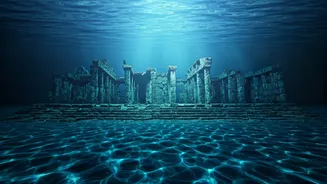
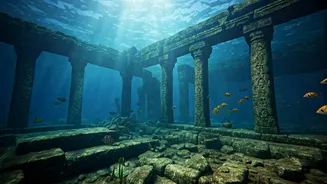
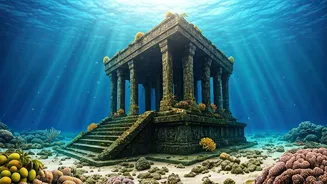
spoken of more. The legend of the 'Seven Pagodas' insists that the Shore Temple was not alone; it was merely the last survivor of a grand complex of seven temples, with its six siblings claimed by the sea. Fishermen through the ages have shared tales of glimpsing the submerged tops of these structures during their voyages. This enduring myth has painted a picture of a glorious city lost to the waves, waiting to be rediscovered.
The First Glimpse Beneath the Waves
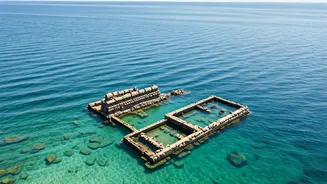
The transition from myth to science began in the early 2000s. A joint expedition by India's National Institute of Oceanography (NIO) and the UK-based Scientific Exploration Society deployed side-scan sonar off the Mahabalipuram coast. The results were tantalizing. They found evidence of submerged walls and scattered, man-made stone blocks lying at depths of five to eight metres. The major turning point came in the aftermath of the 2004 Indian Ocean tsunami. As the sea temporarily receded, eyewitnesses reported seeing long rows of large stones and other structures before the water returned. This prompted a larger investigation by the Archaeological Survey of India (ASI) and the Indian Navy in 2005, which confirmed the existence of walls and the remains of what appeared to be two submerged temples. For the first time, there was concrete evidence that something significant lay hidden offshore.
A New Era of Exploration
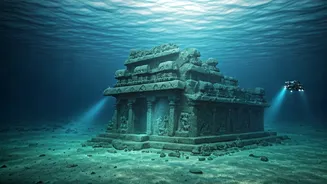
After nearly two decades of quiet, the search has been dramatically reignited. In late 2025, the ASI's Underwater Archaeology Wing (UAW) resumed its explorations, launching a new, technologically advanced mission to unravel the secrets of the deep. While the early surveys relied on sonar, the current team is armed with more sophisticated equipment, most notably a Remotely Operated Vehicle (ROV). This underwater drone can capture high-resolution video and imagery of the seabed without physically disturbing the delicate archaeological site. This technology represents a massive leap forward, allowing archaeologists to get a clearer, more detailed view of the submerged remains and explore deeper areas with greater safety and precision than ever before.
The Mission's Modern Goals
The new mission is about more than just finding ruins; it's about understanding them. Led by senior ASI officials, the UAW team is not starting from scratch but is building on the discoveries of the past. The objective is to create a detailed map of the submerged site and determine the age, layout, and purpose of the structures. By analysing the high-resolution images from the ROV, archaeologists hope to identify architectural features and carvings that can definitively link the ruins to the 7th-8th century Pallava period. This will help answer the ultimate question: are these scattered walls the remains of the legendary 'Seven Pagodas,' or do they belong to an ancient port city that served the Pallava kingdom?