




What Exactly Is XLSSC 122?
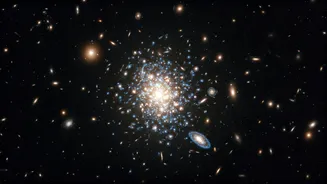
XLSSC 122 is a galaxy cluster, a massive structure composed of hundreds or even thousands of galaxies bound together by gravity. What makes it extraordinary is its sheer distance and age. We see this cluster as it was 10.4 billion years ago, when the universe
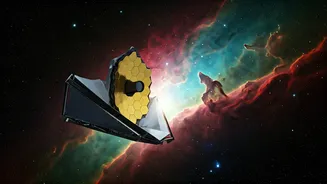
was only about 3.4 billion years old. This period is known as 'cosmic noon,' a frantic era when star formation was at its peak across the cosmos. Initially spotted in 2014 by an X-ray survey, it took the powerful vision of the James Webb Space Telescope (JWST) to reveal its true, puzzling nature. Unlike other clusters from that time, which were expected to be young and disorganized, XLSSC 122 looks surprisingly well-developed, with a dense, concentrated core.
The Core of the Mystery
The central puzzle of XLSSC 122 is that it appears to have grown up too fast. According to our leading theory of cosmic evolution, the Lambda-CDM model, galaxy clusters are supposed to form slowly, gradually pulling in matter over billions of years. Yet, XLSSC 122 has a mass concentration in its core that is far higher than these models predict for such an early stage in the universe's history. Recent JWST observations confirmed this when they detected a phenomenon called 'strong gravitational lensing'—the cluster's immense gravity is so concentrated that it visibly bends and magnifies the light from even more distant galaxies behind it. This makes XLSSC 122 the most distant galaxy cluster ever found to act as such a powerful natural telescope, and it gives astronomers a direct way to weigh its core. The results show a cluster that is far more put-together than it has any right to be.
A New Window into Dark Matter
The mystery of XLSSC 122 is also deeply connected to dark matter, the invisible substance that makes up about 85% of the matter in the universe. While we can't see dark matter, we can detect its gravitational effects. In galaxy clusters, it's the immense gravity of dark matter that holds everything together and bends light for gravitational lensing. By studying the distorted arcs of light around XLSSC 122, scientists can map the distribution of dark matter within this ancient structure. This provides a crucial stress test for our cosmological models. If the dark matter in this cluster is arranged differently or is more concentrated than predicted, it could mean our understanding of this fundamental cosmic ingredient is incomplete.
Challenging the Cosmic Rulebook
So, does one over-achieving galaxy cluster mean our entire understanding of cosmology is wrong? Not by itself. Scientists are careful to note that a single object, however strange, is not enough to overturn a model that has successfully explained the universe for decades. XLSSC 122 could simply be a rare statistical outlier—a cluster that happened to form in an unusually dense patch of the early universe. However, it joins a growing list of discoveries from the JWST that show massive structures forming earlier and more quickly than anticipated. These findings suggest that the process of cosmic assembly might be more rapid or efficient than we thought. XLSSC 122 provides a perfect laboratory to test these new ideas and refine our simulations of how the first massive structures in the universe came to be.
The Hunt for Answers Continues
The discovery of XLSSC 122's unusual properties is not an endpoint but the beginning of a deeper investigation. Further analysis of the JWST data has revealed that the cluster is still dynamically active and in the process of merging. Scientists have also detected the faint 'intracluster light'—a glow from stars that have been ripped from their home galaxies—which is the earliest such detection ever recorded and provides clues about the cluster's chaotic assembly history. By combining JWST's observations with data from X-ray and radio telescopes, astronomers are building a complete, multi-wavelength picture of this unique system. Each new piece of information helps them understand whether XLSSC 122 is a bizarre exception or a signpost pointing toward a new understanding of the cosmos.