







Long hours at a desk can lead to stiff joints, a sore back, and tight hips. The good news is you don't need a full gym session to fight back. Integrating small, simple movements into your workday can make a world of difference for your mobility.
The Real Cost of Sitting
Spending
eight hours a day in a chair might seem harmless, but it puts sustained stress on your body. When you sit for long periods, certain joints are held in a fixed position, while specific muscles remain tense and others go unused. This imbalance can lead to shortened hip flexors, a rounded upper back, and increased pressure on the discs in your spine. Over time, this inaction contributes to joint fluid stagnation, muscle weakness, and even the breakdown of cartilage. The feeling of being 'rusty' after sitting is a real physiological response to a lack of movement, where joints become stiffer and more prone to pain.
1. Undo the 'Tech Neck' with Chin Tucks
Staring at a screen often causes our head to drift forward, straining the muscles in the neck and upper back. The chin tuck is a simple yet powerful exercise to counteract this. While sitting or standing tall, gently draw your chin straight back, as if you are trying to make a double chin, without tilting your head up or down. You should feel a gentle stretch at the base of your skull. Hold for a few seconds and release. Aim to do ten repetitions every hour to reset your posture and relieve neck tension.
2. Free Your Shoulders with Rolls and Squeezes
A slumped posture at a desk weakens the muscles between your shoulder blades. To combat this, perform shoulder rolls by lifting your shoulders up towards your ears, rolling them back and down, and then repeating in the forward direction. Follow this with shoulder blade squeezes: sit or stand tall and actively pull your shoulder blades together and down, as if you’re trying to hold a pencil between them. Hold each squeeze for 3-5 seconds and repeat ten times to activate these underused postural muscles.
3. Mobilise Your Spine with Seated Twists
Your upper back is designed for rotation, but desk work keeps it static. A seated spinal twist can help restore this movement. Sit upright at the edge of your chair with your feet flat on the floor. Gently twist your torso to the right, placing your left hand on your right knee for a light leverage. Hold the stretch, breathing deeply, then slowly return to the centre and repeat on the other side. This simple move helps keep the thoracic spine mobile and reduces the stiffness that builds up during the day.
4. Open Your Hips to Help Your Back
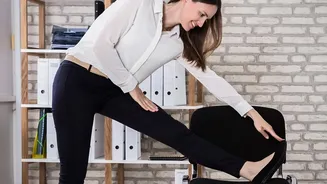
Prolonged sitting keeps your hip flexor muscles in a constantly shortened position, which can lead to tightness and contribute to lower back pain. A standing hip flexor stretch is an excellent remedy. Stand up and take a small step back with one leg, keeping your torso upright. Gently tuck your pelvis and squeeze the glute of your back leg until you feel a stretch in the front of your hip. Hold for 20–30 seconds on each side. This is a great stretch to do during a short break away from your chair.
5. Protect Your Wrists and Ankles
Typing and using a mouse puts repetitive strain on your wrists and forearms. To relieve this, extend one arm in front of you with your palm up. With your other hand, gently pull your fingers down and back towards your body. Hold for 15–20 seconds, then repeat with your palm facing down. Don’t forget your ankles either; prolonged sitting can restrict circulation. While seated, simply rotate your feet in slow, controlled circles, and then point and flex your toes. Do this periodically throughout the day to keep blood flowing.
The Most Important Move: Just Get Up
While specific stretches are beneficial, experts agree that the most crucial habit is to simply reduce continuous sitting. The best posture is your next posture. Set a reminder to stand up and move for a few minutes every 30 to 60 minutes. Walk to get a glass of water, stand during a phone call, or take a quick lap around the office. These small but frequent breaks in sedentary time have a massive cumulative effect on reducing stiffness, improving circulation, and keeping your joints healthy.