




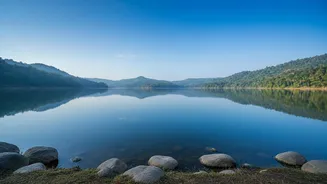
A Lake's Memory in Central India
Deep in the heart of India's Core Monsoon Zone (CMZ), the Raja Rani Lake in Korba district, Chhattisgarh, held a secret. This zone is critical, receiving nearly 90% of India's annual rainfall, making it acutely sensitive to monsoon fluctuations. Scientists
from the Birbal Sahni Institute of Palaeosciences (BSIP) in Lucknow drilled into the lakebed, extracting a 40-centimetre-long sediment core. This seemingly simple tube of mud is a time capsule, preserving environmental records layer by layer, going back approximately 2,500 years. Each layer contains microscopic clues from the past, but the most important of these were the fossilised pollen grains shed by plants that lived centuries ago.
What the Pollen Reveals
The science of reading this ancient story is called palynology—the study of pollen. Plants are sensitive to their climate; some thrive in wet, warm conditions, while others prefer dry environments. By identifying the types and quantities of pollen in each sediment layer, researchers can reconstruct what the surrounding vegetation looked like at a specific point in time, and from that, infer the climate. In the Chhattisgarh core, the scientists found a dramatic story of change. A clear shift from savannah-like grasslands to dense, mixed tropical deciduous forests pointed to a significant increase in moisture and humidity. The dominance of pollen from forest-loving plants provided undeniable evidence of a much stronger and more sustained Indian Summer Monsoon (ISM) than is seen today.
A Stronger Medieval Monsoon
The study pinpoints a specific period of intense rainfall between roughly 1060 CE and 1725 CE. This timeframe coincides with a global warm phase known as the Medieval Climate Anomaly (MCA), when many parts of the world experienced unusual climate patterns. The pollen record from Raja Rani Lake shows that during this era, central India was consistently warm and humid, supporting lush forests. Crucially, the findings contradict some previous notions by showing no evidence of significant dry periods within the Core Monsoon Zone during this time. It suggests a robust and persistent monsoon system, likely influenced by a combination of global factors such as La Niña-like conditions in the Pacific, increased solar activity, and shifts in major climate zones.
Why Ancient Weather Matters Today
Reconstructing past climates isn't just an academic exercise. Understanding the monsoon's natural variability over centuries is vital for India's future. The Chhattisgarh findings provide a crucial baseline of how the monsoon system can behave under different global climatic conditions. This historical data helps scientists refine the climate models used to predict future trends. With modern climate change altering weather patterns, knowing the monsoon's past extremes—its capacity for both intense rainfall and prolonged drought—allows for better preparation. For a country where agriculture, water resources, and the economy are deeply intertwined with the monsoon, looking into the deep past is essential for securing the future. This study demonstrates how local, granular research can have far-reaching implications for national policy and climate resilience strategies.