




1. Seated Cat-Cow
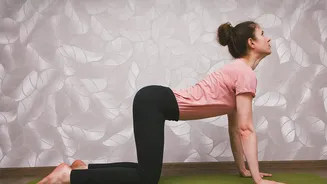
This gentle spinal movement helps to warm up the back and relieve tension. Sit at the edge of your chair with your feet flat on the floor and hands on your knees. On an inhale, arch your back, lift your chest, and look slightly upward toward the ceiling
(Cow pose). As you exhale, round your spine, tuck your chin to your chest, and gently pull your belly button inward (Cat pose). Flow between these two positions for 5-10 slow, controlled breaths to increase spinal mobility.
2. Shoulder Blade Squeezes
This exercise is excellent for combating the slumped-forward posture we often adopt at our desks. Sit tall with your feet flat on the floor. Bend your elbows at a 90-degree angle, keeping them close to your body. Now, gently squeeze your shoulder blades together as if you're trying to hold a pencil between them. Hold this contraction for 5-10 seconds, then release. Repeat this 8-10 times to activate the muscles in your upper back and improve your posture.
3. Overhead Reach
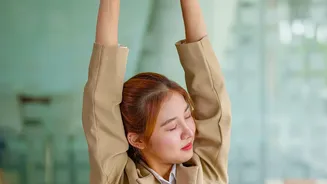
An overhead stretch helps to lengthen the sides of your body and your shoulders. While seated, interlace your fingers and push your palms up toward the ceiling. Raise your arms as high as you can, feeling a stretch through your arms and upper back. For a deeper stretch, gently lean to one side for 10-15 seconds, then repeat on the other side. This movement helps decompress the spine and ease shoulder tension.
4. Upper Trapezius Stretch
The trapezius muscle, which runs from the neck to the shoulders, is a common site of tension. To stretch it, sit up straight and gently tilt your right ear toward your right shoulder. You can place your right hand on your head to apply very light pressure for a deeper stretch. To anchor the stretch, you can sit on your left hand or hold the bottom of your chair. Hold for 20-30 seconds, breathing deeply, and then switch sides.
5. Seated Thoracic Extension
This movement directly counters the hunching posture that causes so much upper back stiffness. Sit tall in a sturdy chair, ideally one with a backrest that hits around your mid-back. Place your hands behind your head with your elbows pointing out to the sides. Gently lean back, arching your upper and mid-back over the top of the chair. Keep your chin slightly tucked and hold the stretch for about 20 seconds, then return to the starting position. This helps open up the chest and extend the thoracic spine.
6. Seated Spinal Twist
Twists are fantastic for improving mobility and relieving stiffness along the spine. Sit upright with your feet flat on the floor. Cross your arms over your chest. Gently twist your torso to the right as far as feels comfortable. You can also place your left hand on your right knee for a slightly deeper twist. Hold for 15-30 seconds, then slowly return to the center and repeat on the left side. The movement should come from your mid-back, not your lower back.
7. Chin Tucks
Often called a neck retraction, this subtle move is powerful for correcting 'forward head' posture and relieving tension at the base of the skull. Sit up straight and look directly ahead. Gently pull your chin and head straight back, as if you are making a double chin, without tilting your head down. You should feel a stretch at the back of your neck. Hold for 5 seconds and then release. Repeat this 8-10 times to help realign your neck over your shoulders.