



The Frozen Treasure of the Lunar Poles
For decades, the Moon was thought to be completely dry. However, missions like India's Chandrayaan-1 and NASA's Lunar Reconnaissance Orbiter (LRO) have confirmed the presence of water ice. This isn't a vast skating rink, but rather ice mixed into the lunar
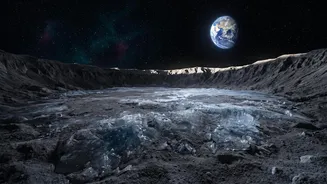
soil, or regolith, primarily found in permanently shadowed regions (PSRs) near the poles. These craters haven't seen sunlight in billions of years, making them cold enough to trap water ice delivered by comets and asteroids over eons. Recent estimates suggest there could be over 600 billion kilograms of water ice at the poles, a resource that has ignited a new space race focused not just on exploration, but on utilization.
The Cosmic Chemistry: From Ice to Fuel
The real magic lies in a simple process called electrolysis. By passing an electric current through water (H₂O), it can be split into its constituent elements: hydrogen and oxygen. These two gases, when cooled into liquid form, are the primary components of modern rocket propellant. Essentially, lunar water ice is a feedstock for producing both fuel (liquid hydrogen) and the oxidizer needed to burn it (liquid oxygen). This process, known as in-situ resource utilization (ISRU), is seen by space agencies like NASA as fundamental to making deep space exploration sustainable. Instead of launching everything from Earth, we can 'live off the land,' dramatically changing the economics of space travel.
Building a Gas Station in the Sky
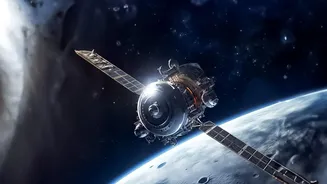
Lifting mass out of Earth's deep gravity well is incredibly expensive, costing thousands of dollars per kilogram. A significant portion of any rocket's mass is the fuel needed just to escape our planet. Imagine a scenario where a spacecraft launches from Earth with only enough fuel to get into orbit. There, it docks with a propellant depot—a 'gas station' in space—and fills its tanks with fuel produced on the Moon. This would allow missions to carry much larger payloads, such as bigger habitats for Mars or more scientific equipment. Studies have shown that even with the high initial cost of setting up lunar mining, producing propellant on the Moon and transporting it to orbit could be significantly cheaper than launching it all from Earth.
The Hurdles on the Horizon
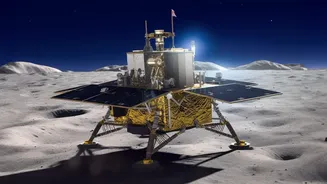
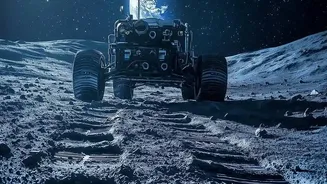
The vision is compelling, but the challenges are immense. First, we need more precise maps of where the ice is located and how concentrated it is. Mining in permanently shadowed craters means operating robotic equipment in extreme cold (plunging below -160°C) and darkness, which requires robust power sources, likely nuclear reactors, as solar power is unavailable in these regions. The process involves extracting the ice-rich regolith, heating it to release the water vapor, purifying it, and then performing electrolysis. Each step requires developing new technologies that can withstand the harsh lunar environment, from dust that can clog machinery to extreme temperature swings.
The Dawn of a Cislunar Economy
Despite the difficulties, the potential payoff is enormous. The ability to refuel in space doesn't just enable government missions to Mars; it opens up a new commercial frontier. Private companies are already planning to extract lunar resources, seeing a future market in selling propellant to NASA, other national space agencies, and commercial satellite operators. This could create a self-sustaining cislunar economy, encompassing activities on and around the Moon. As the infrastructure for mining, processing, and transportation is built, the cost of operating in space would fall, potentially unlocking further opportunities from space tourism to advanced manufacturing. The legal and regulatory framework for managing these resources is still being developed, but the direction is clear: the Moon is poised to become a critical economic and strategic asset.