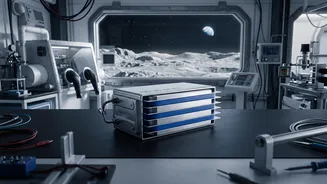







The Challenge of Lunar Power
Imagine a night that lasts for 14 Earth days, with temperatures plunging to minus 200 degrees Celsius. That's the reality on the Moon, especially at the South Pole where future Artemis missions plan to land. For standard lithium-ion batteries, like the ones
in your phone or laptop, this is a death sentence. Their internal liquid electrolytes freeze solid, which can cause permanent damage. Heat them up to the lunar daytime temperature of 100 degrees Celsius, and they also struggle. This extreme temperature swing makes reliable power storage one of the biggest hurdles for long-term lunar habitats, scientific instruments, and rovers designed to explore the darkest, coldest craters.
A Solid Solution to a Liquid Problem
NASA's answer is to get rid of the liquid. The project, officially named Solid Power for Extreme Environment Adaptability and Resilience in Space (SPEARS), is focused on developing solid-state batteries. Instead of a liquid or gel electrolyte that allows ions to flow between the battery's positive and negative ends, this new technology uses a thin, solid material, often a ceramic or polymer. This fundamental change in design makes the battery far more robust. With no liquid to freeze, boil away in the vacuum of space, or leak, the battery becomes inherently safer and more resilient to the harsh lunar environment.
Surviving the Extremes
The key advantage of the SPEARS battery is its ability to survive, even if it can't operate at the lowest temperatures. Recent tests showed that small prototype cells could survive exposure to temperatures as low as minus 170 degrees Celsius without any damage. While they don't produce power when that cold, they don't break. With small, efficient heaters, they can be quickly warmed up to an operational temperature. Tests at NASA's Langley Research Center showed the prototypes operated well from 80 degrees down to minus 60 degrees Celsius, and still functioned with slightly reduced performance at an impressive minus 80 degrees Celsius. This means NASA could avoid the need for heavy, power-hungry thermal management systems designed to keep conventional batteries constantly warm, saving precious weight and energy on missions.
Powering the Artemis Generation
This research is not just a laboratory experiment; it's a critical enabling technology for NASA's Artemis program, which aims to establish a long-term human presence on the Moon. These durable batteries could power a new generation of exploratory rovers, scientific drills used in permanently shadowed craters, and provide emergency backup power for astronaut life support systems. Because the internal chemistry can be adjusted, NASA can create different versions of the battery—some tuned for high power output, others for long-duration energy storage, depending on the specific application. From powering scientific instruments for months at a time to keeping habitats running through the long lunar night, this technology is essential for moving beyond short visits to truly living and working on the Moon.