



More Than Just Heavy Rain
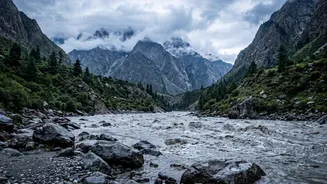
When we think of floods, we usually picture rivers overflowing after days of rain. But in high-mountain regions like Nepal and the Indian Himalayas, the picture is far more complex and violent. While intense monsoon rainfall can trigger flash floods, the most
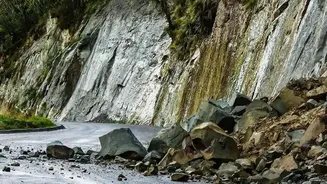
destructive events often have different origins. The region's steep, geologically young, and unstable slopes mean that disasters can cascade. A single event, like a landslide or glacier collapse, can unleash a chain reaction that results in a devastating flood miles downstream with little to no warning from rainfall. These floods are not just water; they are thick, fast-moving slurries of debris, rock, and sediment, giving them immense destructive power.
The Glacial Lake Outburst Threat
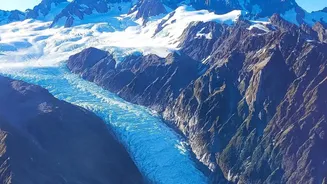
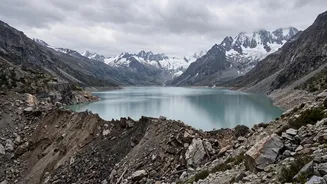
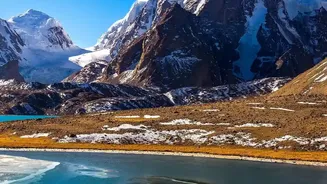
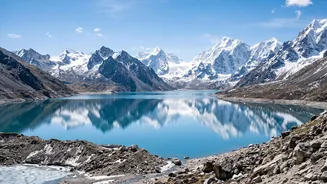
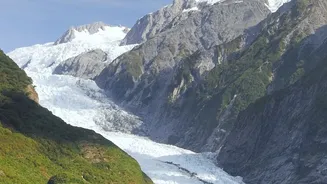
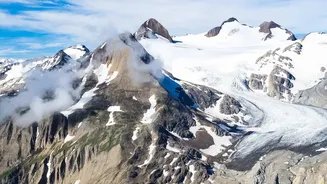
One of the primary culprits behind major Himalayan floods is a phenomenon known as a Glacial Lake Outburst Flood, or GLOF. As climate change accelerates the melting of glaciers, vast lakes of meltwater are forming at their edges, often held in place only by unstable natural dams of loose rock and ice called moraines. These moraine dams can fail for several reasons. An ice or rock avalanche could crash into the lake, causing a massive wave to overtop the dam. Alternatively, rising water pressure or even an earthquake could cause the dam to breach catastrophically. When this happens, the entire lake can drain in a matter of hours or even minutes, releasing a torrent of water equivalent to millions of cubic meters, carving out the landscape as it rushes downstream.
The Science of the Surge
The destructive power of a GLOF or a landslide-triggered flood comes from its transformation into a 'debris flow'. As the initial burst of water surges down steep valleys, it picks up enormous amounts of sediment, boulders, and uprooted trees. This mixture becomes a dense, concrete-like slurry that moves at incredible speeds. Unlike a water flood, which might flow around a building, a debris flow has enough mass and force to destroy concrete bridges and buildings in its path. The sheer weight and erosive power of the flow can scour riverbeds and banks, adding even more material and growing in volume as it travels, which is why these events are so much more destructive than rain-fed floods.
Hearing the Disaster's Seismic Signal
In a fascinating intersection of geology and hydrology, scientists have discovered that these massive flows are so powerful they can be 'heard' by seismometers — the same instruments used to detect earthquakes. The movement of millions of tonnes of rock, water, and debris rumbling down a valley generates powerful vibrations in the ground. These vibrations create a unique seismic signature, a low-frequency noise distinct from the sharp jolt of a tectonic earthquake. In some cases, initial reports of an earthquake have been re-analysed and correctly identified as the seismic signal of a massive landslide or debris flow. Researchers can analyse these signals to track the flood's progress, estimate its speed, and even gauge the amount of debris it carries.
A New Kind of Early Warning
The discovery of this seismic footprint has profound implications for disaster management. Seismic waves travel through the ground much faster than the flood itself can move. This means a seismometer placed downstream could detect the rumbling of a GLOF or landslide-triggered flood minutes before the destructive wave arrives. In remote, high-altitude regions where visual monitoring is difficult and telecommunication infrastructure is sparse, this provides a potential lifeline. While it may not be a long lead time, those precious minutes can be enough to trigger automated alarms and allow for the evacuation of downstream communities. It represents a crucial shift from simply reacting to disasters to actively monitoring for their tell-tale signs, using the Earth's own vibrations as a warning system.