
A Storm for the Ages
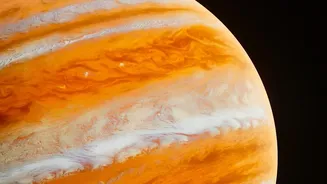
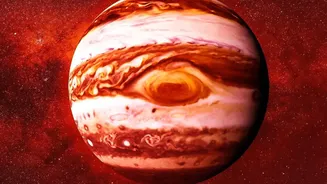
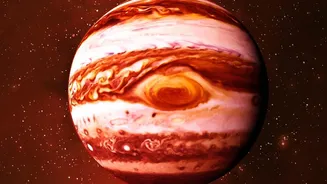
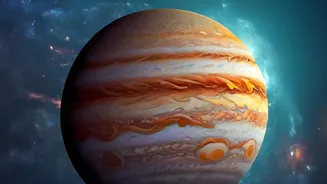
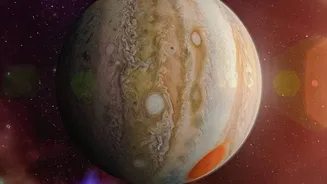
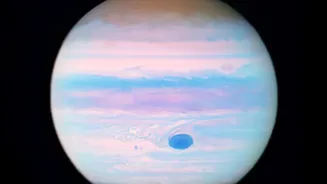
The Great Red Spot is an enormous anticyclone, a high-pressure system spinning counterclockwise in Jupiter's southern hemisphere. Though its discovery is sometimes attributed to the 17th century, consistent observations date back to the late 1800s. Back
then, the storm was vast enough to swallow three Earths. Today, it is about 1.3 times the width of our planet, a dramatic downsizing that has fascinated astronomers for decades. This gigantic storm is a cornerstone of planetary science, a natural laboratory for understanding atmospheric dynamics on a scale unimaginable on Earth. Its distinctive red-orange hue is thought to come from chemical compounds in the upper atmosphere, though the exact recipe remains a topic of study.
What the New Images Reveal
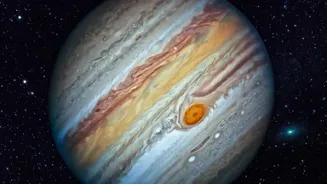
Recent observations, particularly from the Hubble Space Telescope, have given scientists an unprecedented look at the storm's behaviour. These images show that the Great Red Spot is not just shrinking; its internal dynamics are shifting. While the spot has been getting smaller for over a century, studies have revealed that the wind speeds in the storm's outer lanes have actually increased, while winds in the innermost region seem to be slowing. Furthermore, the spot is becoming more circular and less of an oval. The most surprising recent discovery is that the storm oscillates and jiggles, changing its size and shape over short periods. Scientists have observed it squeezing and stretching, a behaviour that current atmospheric models had not predicted.
The Science of a Shrinking Giant
So, what is causing these changes? The answer is complex and not fully understood. One leading theory is that the Great Red Spot's diet is changing. The storm is known to sustain itself by absorbing smaller, nearby storms, or anticyclones. When these smaller vortices are 'eaten' by the larger storm, they transfer energy that helps maintain its momentum. Some recent simulations suggest that a decrease in the number of these smaller storms available for consumption could be a reason for the Great Red Spot's gradual shrinking. However, these interactions are also disruptive. When smaller storms collide with the Great Red Spot, they can tear off red-coloured flakes from the main storm, temporarily distorting its shape. Despite these violent encounters, scientists believe the interactions are superficial and do not affect the full depth of the vortex, which allows it to survive.
Why We Keep Watching
Studying the Great Red Spot is about more than just curiosity. Jupiter is a gas giant, a world profoundly different from our own rocky planet. Its massive, turbulent atmosphere provides crucial insights into how weather systems work on a grand scale. Understanding the dynamics that power a storm that has lasted for centuries helps scientists refine their models of planetary atmospheres, which can then be applied to Earth's weather and climate systems. It also informs our search for and understanding of exoplanets—planets orbiting other stars—many of which are gas giants like Jupiter. Each new image and data point helps solve a piece of the puzzle, not just about Jupiter, but about the fundamental laws of physics that govern planets across the universe.