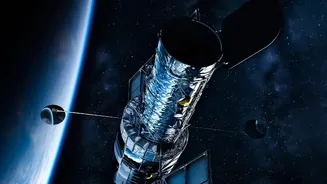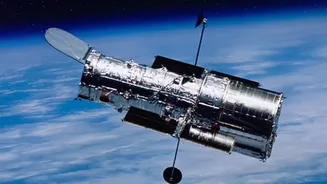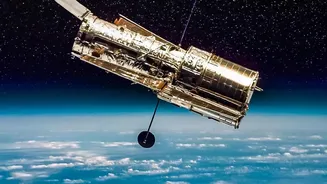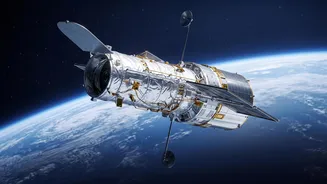






For over 35 years, the Hubble Space Telescope has been humanity’s eye on the cosmos. But its legendary mission is at risk as its orbit decays. Now, NASA is turning to the commercial space industry for an unprecedented rescue plan.
The Inevitable Descent
Like every object in
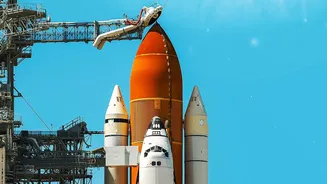
low-Earth orbit, the Hubble Space Telescope is in a constant battle with gravity and atmospheric drag. Since its launch in 1990 and its last servicing mission in 2009, it has been slowly but surely falling. Originally placed in an orbit of about 600 kilometers, its altitude has now dropped significantly. Without an onboard propulsion system to counteract this decay, its fate is sealed: a fiery reentry into Earth's atmosphere. Current projections estimate this will happen sometime between 2033 and 2034, giving NASA a ticking clock to find a solution. This orbital decay is not a new problem; Space Shuttle crews performed reboosts on previous servicing missions, with the last one occurring in 2002. But with the shuttle fleet retired, NASA no longer has a homegrown way to reach its most famous observatory.
A Call for Commercial Ideas
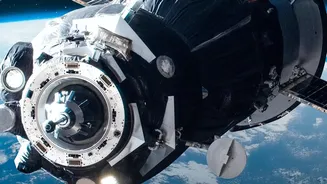
Recognizing the urgency, NASA issued a formal Request for Information (RFI) on October 29, 2026, opening the door for private companies to propose solutions. This isn't a contract, but a way for the agency to survey the market and understand what is technically and financially possible. The RFI outlines three potential paths for commercial partners to consider. The first and most hopeful option is a 'reboost' mission: a spacecraft would rendezvous with Hubble, latch on, and push it into a higher, more stable orbit of at least 600 kilometers, potentially adding 15 to 25 years to its operational life. The second option involves servicing the telescope to enhance its performance. The third is a plan for its end-of-life: guiding it to a safe, controlled deorbit to prevent it from falling uncontrollably. Any proposed mission would have to fly by 2032 to be effective.
The New Space Economy Steps Up
Why turn to private industry? The decision reflects a major strategic shift at NASA, which has increasingly relied on public-private partnerships to achieve its goals. Programs like Commercial Crew and Commercial Resupply Services, which use companies like SpaceX to ferry astronauts and cargo to the International Space Station, have already proven the model's success. These partnerships are seen as a way to drive innovation, reduce costs for taxpayers, and foster a robust commercial space economy. For the Hubble mission, a private company would be responsible for providing the launch vehicle, the servicing spacecraft, and mission operations, including a human crew if needed. This move leverages the rapid growth in the commercial sector, where companies like Astroscale, Momentus, and SpaceX are developing capabilities for in-space servicing, rendezvous, and docking.
Potential Players and Past Proposals
This isn't the first time a private Hubble rescue has been discussed. In 2022, NASA and SpaceX signed an agreement to study the feasibility of using a Dragon spacecraft for a reboost mission, an idea championed by billionaire and private astronaut Jared Isaacman's Polaris Program. While that specific plan was not pursued at the time, with some internal concerns noted over risks and technical readiness, it laid the groundwork for the current, broader inquiry. The new RFI is open to the entire industry, inviting a range of concepts, from robotic 'tugs' to crewed missions. A robotic mission could be less expensive and avoid the risks of sending astronauts, but a crewed mission offers greater flexibility to handle unexpected challenges with a 36-year-old spacecraft. The responses, due by November 30, 2026, will give NASA a clear picture of who is ready to take on this historic challenge and what it might cost.