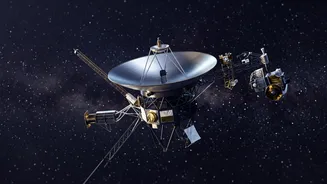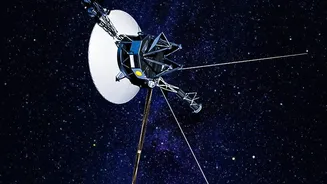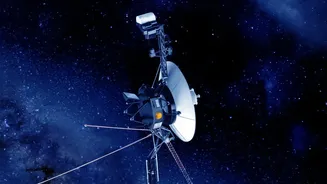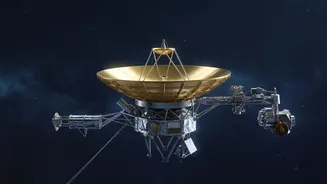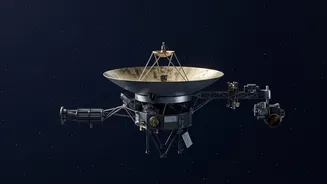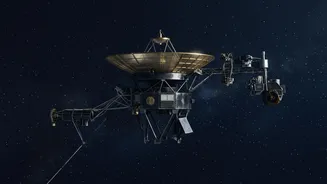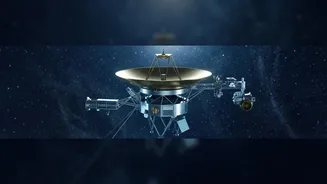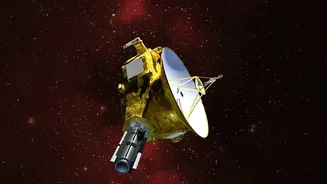

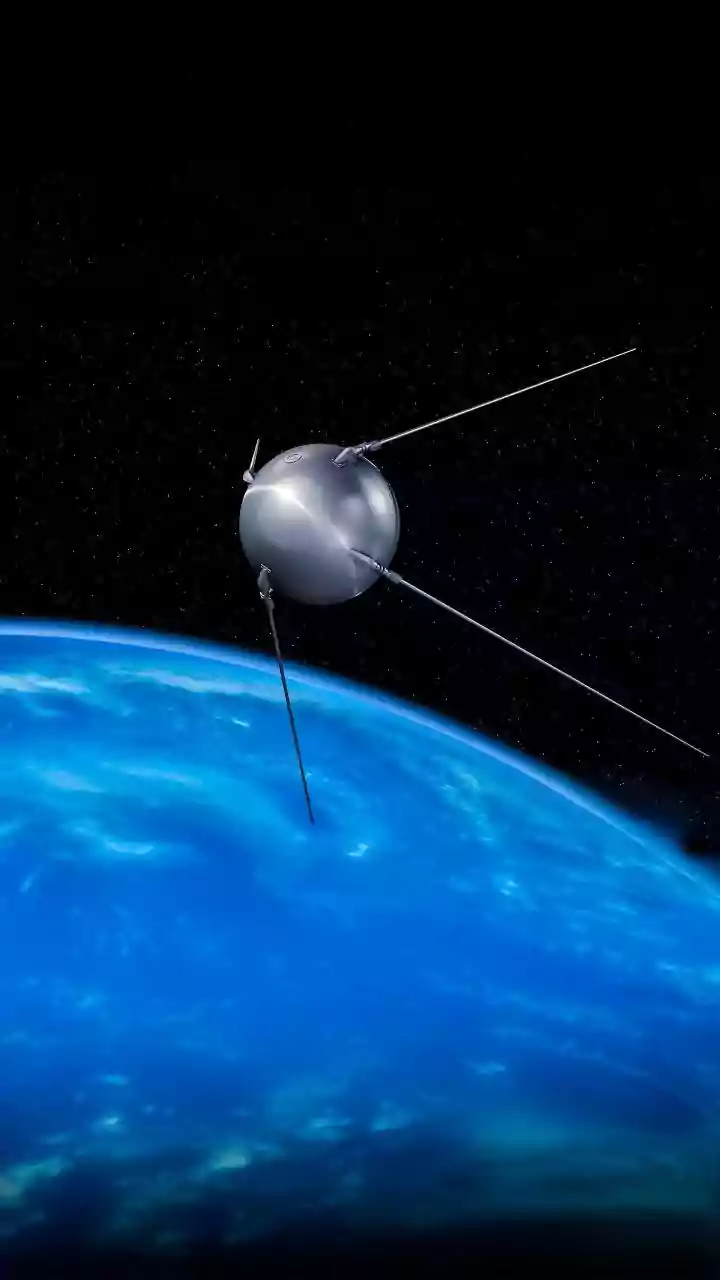

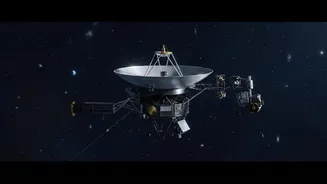
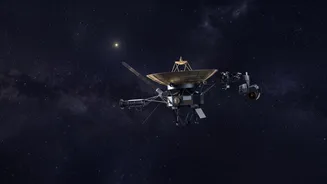
Nearly 50 years after leaving Earth, NASA’s Voyager 1 is about to hit a milestone that redefines 'long-distance'. On November 18, it will be one light-day away, a first for any human-made object and a true test of deep-space communication.
Humanity's Farthest Emissary
Launched on
September 5, 1977, Voyager 1 is a testament to enduring engineering and boundless curiosity. Its original mission was to explore the gas giants, Jupiter and Saturn, and it fundamentally rewrote our understanding of them. It discovered new moons, revealed volcanic activity on Jupiter's moon Io, and studied the complexities of Saturn's rings. After its planetary flybys, its trajectory flung it towards the outer reaches of the solar system. In August 2012, it achieved another historic first by crossing the heliopause—the boundary where the Sun's magnetic field and solar wind give way to the interstellar medium. This made Voyager 1 the first human-made object to enter interstellar space, the vast ocean between stars.
What Exactly is a Light-Day?
We often hear about 'light-years' when discussing cosmic distances, but the 'light-day' is a more manageable, yet still immense, unit of measurement. It is simply the distance light, the fastest thing in the universe, travels in a vacuum in 24 hours. That equates to approximately 25.9 billion kilometres (about 16.1 billion miles). To put that into perspective, light from the Sun takes about 8 minutes to reach Earth, making our star 8 light-minutes away. Neptune, the most distant planet in our solar system, is about 4 light-hours away. On November 18, 2026, Voyager 1 will be so far away that it will take a full 24 hours for its radio signal, travelling at the speed of light, to reach us.
The November 18 Milestone
On November 18, 2026, Voyager 1 will officially be one light-day distant from Earth. This isn't a physical boundary but a milestone in communication. From this point forward, a simple 'conversation' with the probe will take two days. A command sent from NASA's Deep Space Network will travel for 24 hours to reach the spacecraft. Then, any data or confirmation signal sent back by Voyager 1 will take another 24 hours to complete its journey to Earth. This 48-hour roundtrip time highlights the immense challenge of controlling a probe that is now nearly 173 times farther from the Sun than Earth is. Its twin, Voyager 2, which took a longer route to visit Uranus and Neptune, is expected to reach the same milestone in 2035.
A Faint Whisper from the Void
Despite being nearly half a century old and billions of kilometres away, Voyager $is still operational. Its power comes from a radioisotope thermoelectric generator, which has been slowly decaying over the decades. To conserve energy, engineers have been methodically shutting down instruments, with only a couple still collecting scientific data from interstellar space. Communication itself is a marvel, requiring a global network of massive radio antennas to capture the probe's faint signal, which is now weaker than a refrigerator light bulb. The mission has faced recent scares, including a $48$-hour communication blackout in October $2026$ that the spacecraft managed to resolve on its own$,$ a testament to its robust $1970$s$-era technology.
The Enduring Legacy of Voyager
Voyager $^$s journey is more than a series of scientific achievements$;$ it represents a core part of the human spirit. It carries the 'Golden Record', a gold$-plated disc containing sounds and images of life on Earth$,$ intended as a message in a bottle for any intelligent life that might one day find it. The mission also gave us the iconic 'Pale Blue Dot' photograph$,$ a humbling image of Earth seen from $6$ billion kilometres away that was championed by astronomer Carl Sagan. Even as its power fades$,$ Voyager $^$s mission continues. It is currently speeding towards a star named Gliese $445$ at nearly $61$,$000 km/h$,$ though it won'$t pass by it for another $40$,$000 years. It is a silent$,$ enduring ambassador for humanity$,$ journeying into the cosmic darkness long after its signal fades.