




The Ultimate Logistics Challenge
Imagine building a house, but every single nail, brick, and bag of cement costs tens of thousands of dollars to ship to your construction site. That's the economic reality of building on the Moon. Transporting materials from Earth is prohibitively expensive
and a major bottleneck for long-term space exploration. This is why space agencies like NASA and the European Space Agency (ESA) are heavily invested in a concept called In-Situ Resource Utilization, or ISRU. The goal is simple in theory but complex in practice: live off the land. For lunar pioneers, this means using what the Moon provides in abundance—sunlight for power and the loose layer of soil and fragmented rock, known as regolith, as a primary building material.
Moon Dust: A Builder's Dream and Nightmare
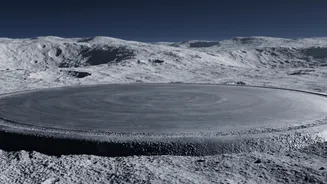
Lunar regolith is a peculiar material. Formed over billions of years by micrometeorite impacts, it's a mix of fine, glassy dust and sharp, abrasive rock fragments. This dust is a notorious hazard; its tiny, electrostatically charged particles cling to everything, threatening to damage equipment and pose health risks to astronauts. However, this same material is rich in elements like silicon, aluminum, iron, and oxygen, making it a prime candidate for construction. The key is to transform this loose powder into solid, durable structures that can protect habitats and their inhabitants from the Moon's extreme environment—savage temperature swings, the vacuum of space, and constant radiation.
Robots, Lasers, and 3D Printing
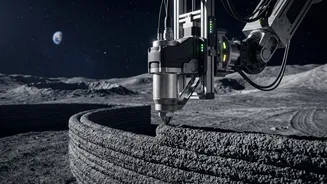
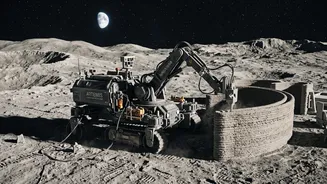
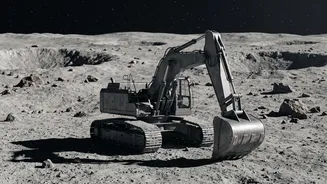
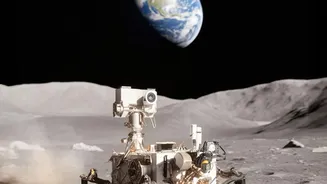
So, how do you turn dust into a dwelling? The leading method is a form of 3D printing called sintering. Autonomous rovers would first excavate the lunar soil. Then, a specialized printing system would use a focused heat source—like a powerful laser, concentrated sunlight, or microwaves—to heat the regolith to just below its melting point, fusing the particles together layer by layer. Over time, this process can create solid blocks, landing pads, roads, and protective berms. Various projects are actively developing this technology. The ESA's PAVER project explores using lasers to melt regolith into glassy surfaces, while NASA has funded companies like ICON and Redwire to develop robotic construction systems and microwave-based sintering technologies, respectively. China also has ambitious plans to 3D-print bricks from lunar soil for its proposed International Lunar Research Station, with a mission planned around 2028 to test the technology on-site.
The Robotic Construction Crew
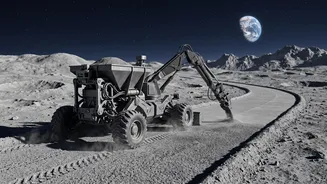
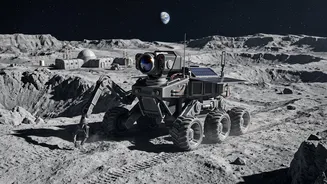
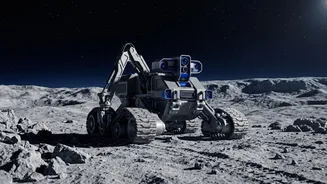
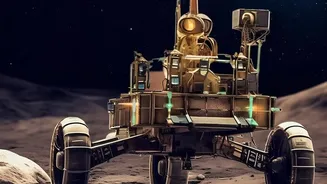
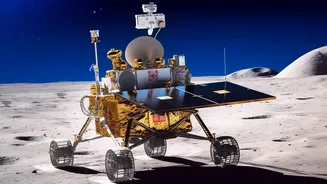
The entire process is envisioned to be highly automated, with robotic systems doing the heavy lifting long before humans arrive. NASA's Artemis program outlines plans for a 'Moon base infrastructure' built out by autonomous machines. This includes robotic arms like the COLDArm, designed to operate in cryogenic temperatures, and rovers capable of excavation and assembly. Upcoming missions plan to deploy small, hopping robots called MoonFall drones to scout construction sites near the lunar south pole. NASA hopes to establish a steady cadence of uncrewed landings starting around 2027 to build up this infrastructure. These robotic crews will need to be incredibly resilient to handle the abrasive dust and function in a place with no atmosphere and extreme temperature swings.
From Theory to a Lunar Reality
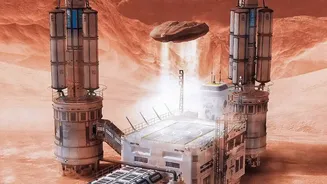
While significant progress has been made using simulated moon soil on Earth, many challenges remain. The fine dust is notoriously hard to handle, and ensuring the structural integrity of 3D-printed parts in a vacuum and low gravity is a major engineering hurdle. Some concepts draw inspiration from ancient building techniques, proposing to sinter interlocking bricks that can be assembled by robots, much like a mortise-and-tenon joint. Other ideas involve filling durable bags with regolith to create simple, versatile construction blocks for radiation shielding. Architectural firms like Foster + Partners and Hassell are already collaborating with the ESA on advanced concepts for entire lunar settlements, combining inflatable habitats with 3D-printed regolith shells to create thriving communities for up to 144 people.