



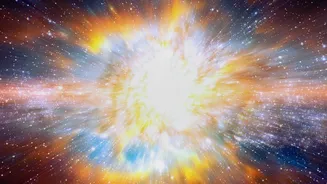
A New Star Challenges Old Beliefs
For centuries, European thought was dominated by the Aristotelian view of the universe: an imperfect, changing Earth at the center, surrounded by perfect and immutable celestial spheres. But this idea was beginning to crumble. Just a few decades earlier,
in 1572, astronomer Tycho Brahe had documented another 'new star' (a supernova), proving that the heavens could, in fact, change. When SN 1604 blazed into view in the constellation Ophiuchus, it provided another powerful piece of evidence against the old model. First spotted in Italy and China, it was visible for about a year, at its peak even outshining Jupiter and being visible during the day. It was the last supernova to be unquestionably observed with the naked eye in our own Milky Way galaxy.
Kepler's Meticulous Observations
Although he wasn't the first to see it, German astronomer Johannes Kepler began observing the star from Prague on October 17, 1604. His work was so thorough that the event was eventually named after him. At the time, the telescope had not yet been turned to the sky; Galileo would do so five years later. Kepler's observations, made entirely with the naked eye, were remarkably precise. He carefully measured the star's position and brightness, noting that it showed no discernible movement against the background of distant stars. This lack of parallax was crucial, as it proved the object was far beyond the Moon, in the realm of the supposedly unchangeable stars. Kepler documented his findings in his 1606 book, 'De Stella Nova in Pede Serpentarii' ('On the New Star in the Foot of the Serpent-Bearer'), creating an essential record of the event.
What Observers in 1604 Actually Saw
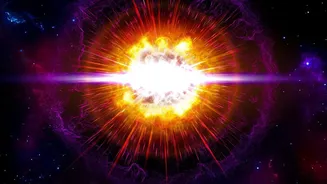
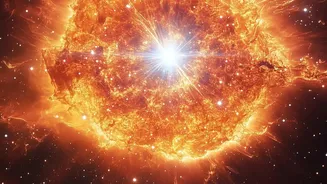
What Kepler and his contemporaries believed was the birth of a new star was actually the spectacular death of an old one. Modern astronomers have classified SN 1604 as a Type Ia supernova. This specific type of stellar explosion occurs in a binary star system, where two stars orbit each other. One of these stars is a white dwarf, the dense, collapsed core of a once-sunlike star. The white dwarf's powerful gravity pulls material from its companion star. When the white dwarf accumulates too much mass and reaches a critical limit, it triggers a runaway thermonuclear explosion that completely obliterates it. This violent event releases an immense amount of energy and forges heavy elements, like the iron that is essential for life.
The Remnant Through Modern Eyes
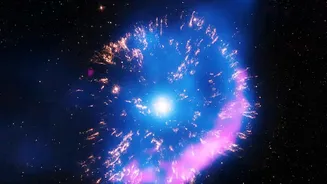
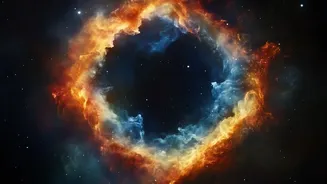
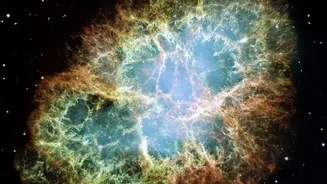
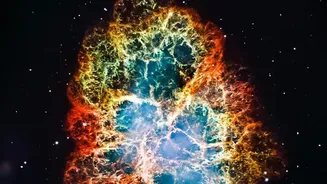
Today, the aftermath of that 400-year-old explosion is known as Kepler's Supernova Remnant. It is a beautiful, expanding cloud of gas and dust located about 20,000 light-years from Earth. While faint in visible light, the remnant glows brightly in other wavelengths. NASA's Great Observatories—the Chandra X-ray Observatory, the Hubble Space Telescope, and the Spitzer Space Telescope—have all studied it, each revealing different features. Chandra detects extremely hot gas heated by the explosion's shockwave, Hubble sees the shockwave slamming into interstellar gas, and Spitzer reveals heated dust particles. Together, they create a complete picture of a structure about 14 light-years wide and expanding at millions of miles per hour.
A Cosmic Yardstick and Lasting Legacy
Kepler's Supernova did more than just help dismantle an ancient worldview. Type Ia supernovae have become one of the most important tools in modern cosmology. Because they are all thought to explode with a consistent peak brightness, they can be used as 'standard candles' to measure vast distances across the universe. By observing how dim these supernovae appear, astronomers can calculate how far away they are. This technique was famously used to discover that the expansion of the universe is accelerating. Ongoing studies of the remnant, including a long-term video created from over two decades of Chandra data, continue to reveal how the debris from the shattered star expands and interacts with its surroundings, providing invaluable insights into the physics of these colossal explosions.