



You Don't Need Expensive Gear
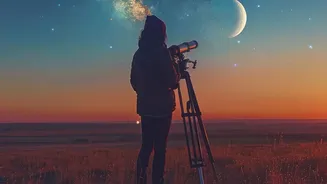
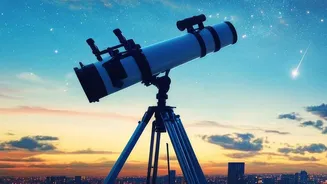
The most common myth about astronomy is that it requires a costly telescope. The truth is, the best tools to start with are your own two eyes. Before spending a single rupee, your first goal should be to simply get acquainted with the night sky. Learn
to spot the brightest stars and track the Moon's phases. If you decide to upgrade, skip the cheap, unstable telescopes often marketed to beginners. Instead, a good pair of binoculars (7x50 or 10x50 are popular choices) will reveal craters on the Moon, the moons of Jupiter, and countless stars invisible to the naked eye. They are portable, versatile, and offer a wide field of view that makes finding objects much easier than with a telescope.
August 2026: A Month of Celestial Events
This August is a fantastic time to begin your skywatching journey, with several major events gracing the skies. The main highlight is the Perseid meteor shower, which peaks on the night of August 12-13. This year's shower is expected to be spectacular because it coincides with a new moon, meaning the skies will be exceptionally dark, allowing even faint meteors to shine. Under ideal conditions, you could see up to 100 meteors per hour. The best time to watch is from midnight until dawn. Additionally, a remarkable six-planet parade will be visible in the pre-dawn sky around August 12. Mars and Saturn will be the easiest to spot with the naked eye, while Jupiter and Mercury will be visible but very low on the eastern horizon. You'll need binoculars or a small telescope to catch a glimpse of Uranus and Neptune. On August 9, you can also see the Moon appear close to Mars in the early morning sky.
How to Beat Urban Light Pollution
The biggest challenge for any city-based stargazer is light pollution. The glow from streetlights, buildings, and advertisements washes out all but the brightest celestial objects. But you can take steps to mitigate it. First, find the darkest spot you can. This might be a park, a terrace, or even just a corner of your balcony that is shielded from direct streetlights. Second, give your eyes time to adapt. It takes at least 20-30 minutes for your eyes to become fully accustomed to the dark, revealing fainter stars. Avoid looking at your bright phone screen during this time. Third, timing is everything. The best time for stargazing is usually after midnight, when some city lights may be turned off and the sky is at its darkest. Plan your sessions around the new moon, as moonlight is a major source of natural light pollution.
Your Smartphone is a Planetarium
Modern technology has made identifying celestial objects incredibly easy. Several free and paid smartphone apps can turn your phone into a portable planetarium. Apps like Stellarium, SkyView Lite, and Star Walk 2 use your phone's location and sensors to show you a real-time map of the sky. Simply point your phone at a bright object, and the app will identify it for you, whether it's a planet, a star, or a satellite. Many of these apps also feature an augmented reality (AR) mode, which overlays constellation lines and object names onto your live camera view, making it intuitive to learn your way around the cosmos. They also include calendars of upcoming celestial events, so you'll never miss an opportunity to look up.
Finding Your Stargazing Community
Stargazing can be a solitary hobby, but it's often more rewarding when shared. India has a vibrant community of amateur astronomers. Look for local astronomy clubs in your city; many of them host public observation sessions and workshops. These are fantastic opportunities to look through powerful telescopes and learn from experienced observers. If you can't find a local club, there are numerous online forums and social media groups dedicated to astronomy in India. Joining these communities allows you to ask questions, share your observations, and stay motivated. Sharing the awe of spotting Saturn's rings for the first time or watching a meteor streak across the sky connects you not just with the universe, but with fellow enthusiasts.