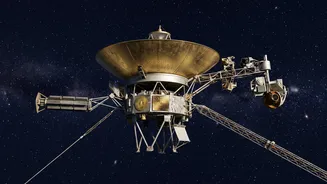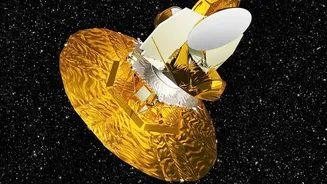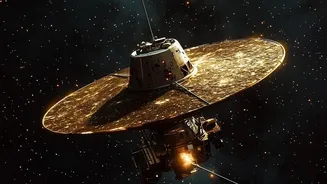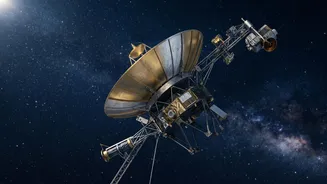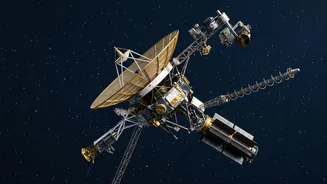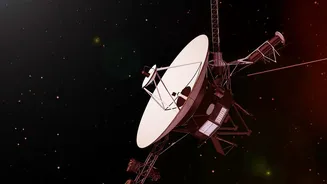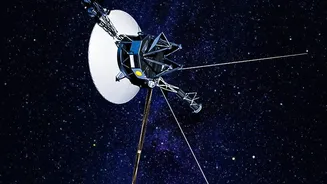

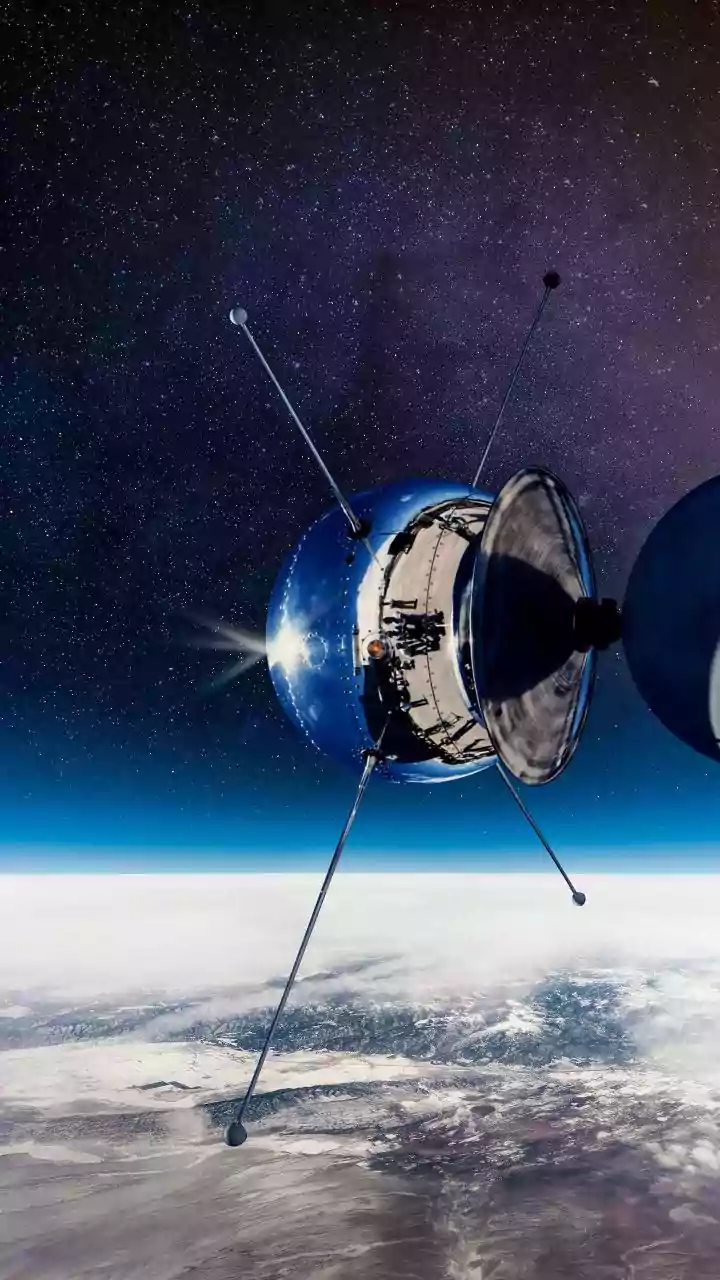



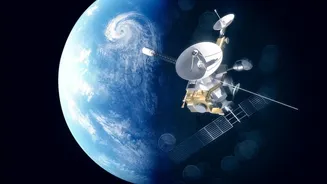
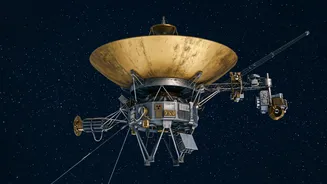
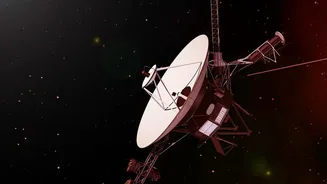
It’s humanity’s farthest messenger, a lone probe sailing through interstellar space more than 24 billion kilometres away. After months of sending gibberish, NASA’s venerable Voyager 1 is talking again, thanks to a stunning feat of engineering.
A Voice From the Void
Launched
in 1977, Voyager 1 and its twin, Voyager 2, were initially sent on a 'grand tour' of the outer planets. They revolutionised our understanding of Jupiter and Saturn, discovering active volcanoes on Jupiter's moon Io and the complexities of Saturn's rings. Its primary mission complete, Voyager 1 continued onward, eventually crossing into interstellar space in 2012, the first human-made object to do so. For nearly 50 years, it has been our remote presence in the cosmos, carrying a 'Golden Record' with sounds and images from Earth. Now, at an almost unimaginable distance, it continues to send back data about the environment between the stars.
The Sound of Silence
In November 2025, the steady stream of valuable data from Voyager 1 stopped. Instead, the probe began transmitting a nonsensical, repeating pattern of binary code. While the spacecraft was still sending a signal, the information it carried was completely unusable. Engineers at NASA's Jet Propulsion Laboratory (JPL) faced a daunting task: diagnosing a computer glitch on a 49-year-old probe so far away that a radio signal takes nearly a full day to reach it. The team eventually traced the problem to a specific component called the flight data subsystem (FDS), which is responsible for packaging all the science and engineering data before it's sent to Earth.
An Unprecedented Repair Job
Fixing the FDS was a monumental challenge. With a 45-hour round-trip communication time for every command and response, the troubleshooting process was painstakingly slow. In early 2026, the team sent a command known as a 'poke' to prompt the FDS to send a full memory readout. This revealed the root of the problem: a single faulty memory chip had become corrupted, affecting about 3% of the FDS memory. The cause remains uncertain; it could have been struck by a high-energy cosmic particle or simply worn out after nearly five decades in space. Since repairing the chip was impossible, engineers devised an ingenious workaround. They carefully dissected the affected software code and found new, separate places to store it within the FDS's memory, essentially bypassing the broken section entirely.
What the Probe Is Saying Now
The creative fix worked. In April 2026, Voyager 1 began transmitting readable engineering data for the first time in five months, confirming the spacecraft was healthy. Over the following weeks, the JPL team methodically brought its scientific instruments back online. As of early November, all four of its active instruments have resumed sending usable science data. These instruments continue to measure cosmic rays, magnetic fields, and plasma waves, providing humanity's only direct measurements from interstellar space. The probe's renewed voice is a testament to the engineers who, decades after the probe was launched, could still understand and manipulate its vintage 1970s technology from across the solar system.
An Enduring Legacy of Ingenuity
The successful repair of Voyager $1$ is more than just a technical victory; it's a powerful story about human persistence and ingenuity. The engineers who designed and built the probe could never have anticipated this specific failure, yet they built it robustly enough that a future generation of engineers could save it. Each new piece of data extends a mission that has already rewritten textbooks. While the probe’s nuclear power source is slowly dwindling, NASA engineers have found clever ways to conserve energy, potentially keeping at least one instrument running into the $2030$s. For now, humanity's most distant explorer continues its journey, a resilient little craft sailing on an ocean of stars.