



Europe's Dark Universe Detective
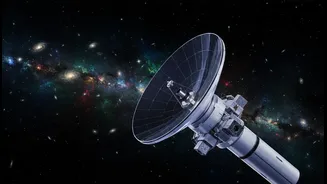
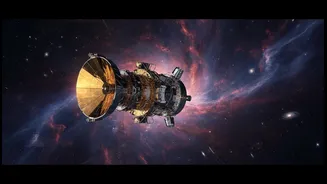
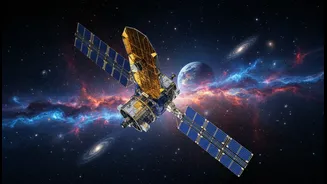
Launched in July 2023, the European Space Agency's Euclid telescope has a grand mission: to map the dark universe. Stationed 1.5 million kilometres from Earth, its primary goal is to understand the enigmatic forces of dark matter and dark energy that
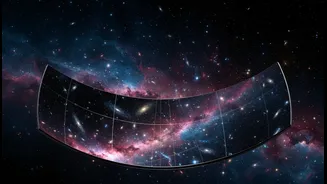
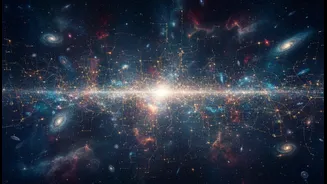
shape our cosmos. To do this, Euclid is creating the largest, most accurate 3D map of the universe ever produced, observing billions of galaxies across more than a third of the sky. But in the process of hunting for cosmic shadows, it has begun to illuminate the most ancient sources of light.
Peering into the Cosmic Dawn
Before the first stars ignited, the universe was a dark, cold place filled with neutral hydrogen gas, an era aptly named the 'Cosmic Dark Ages'. The 'Cosmic Dawn' marks the end of this period, when gravity pulled matter together to form the first stars, galaxies, and black holes. Their brilliant light began to heat and ionise the surrounding gas, ending the darkness in a universe-wide event called the 'epoch of reionisation'. This period, which started a few hundred million years after the Big Bang, is a crucial but poorly understood chapter of cosmic history. Observing it is like trying to watch the precise moment a seed sprouts, but on a universal scale.
Cosmic Lighthouses Called Quasars
Quasars are the perfect beacons for studying this era. Short for 'quasi-stellar radio sources', they are not stars but the intensely bright centres of distant galaxies. At the heart of each quasar lies a supermassive black hole, millions or even billions of times the mass of our sun. As these colossal black holes voraciously consume surrounding gas and dust, the material heats up to extreme temperatures, creating a glare that can outshine all the stars in its host galaxy combined. Because their light has travelled for billions of years to reach us, quasars serve as time machines, offering a direct look into the universe's infancy.
A Record-Breaking Discovery
Recently, astronomers using Euclid announced a stunning find: a trove of 31 ancient quasars, more than doubling the number known from that early epoch. Two of these are the most distant quasars ever observed, shining when the universe was only about 670 million years old, just five percent of its current age. What makes this discovery revolutionary is not just the record-breakers, but the entire population of objects found. Previous searches tended to find only the brightest, most extreme examples. Euclid's powerful infrared vision and wide-sky survey allows it to find more 'typical' and fainter quasars from this period, giving scientists their first true census of these objects at the dawn of time.
A Puzzle for Modern Physics
This new data presents a profound cosmic puzzle. Finding so many supermassive black holes so early in the universe challenges our understanding of how they grow. Current models suggest it should take much longer for a black hole to accumulate such enormous mass. The existence of these ancient giants implies that they either formed from massive initial 'seeds' or grew much faster than theories predicted. As one scientist noted, these objects are key to understanding one of the greatest mysteries in astrophysics. Each new quasar provides another piece of the puzzle, helping scientists refine their models of how the first black holes and galaxies co-evolved.