


Cosmic Messengers from Afar
Our solar system is not entirely isolated. Occasionally, a visitor from another star system, known as an interstellar object, zips through our cosmic neighbourhood. These objects, typically comets or asteroids, are ejected from their home systems and
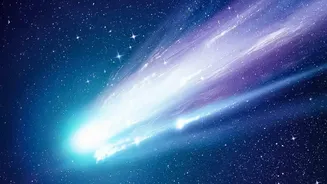
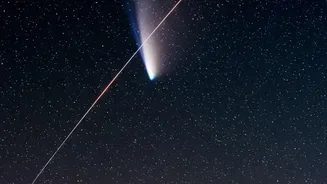
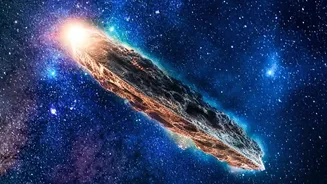
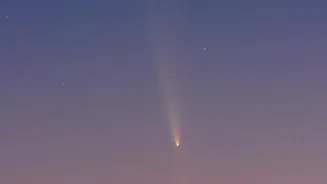
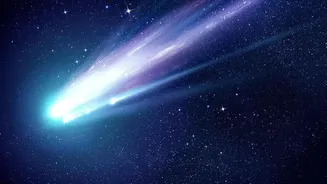
travel for millions of years through the Milky Way. So far, we have confirmed only three such visitors. The first was 1I/ʻOumuamua, a mysterious, elongated object discovered in 2017 that showed no visible tail, or coma. The second, 2I/Borisov, found in 2019, looked much more like a conventional comet, complete with a cloud of dust and gas. The third, designated 3I/ATLAS, was identified in 2025. Each one is a scientific prize, as they are our only way to physically study material from another planetary system without sending a probe, offering a free sample delivered right to our doorstep.
The Tale of Two Visitors
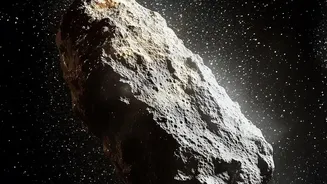
The first two interstellar objects were dramatically different. ‘Oumuamua, which means "messenger from afar" in Hawaiian, baffled scientists. It was highly elongated, maybe ten times as long as it was wide, and appeared to be a dense object made of rock and metal with no water or ice. It also accelerated away from the Sun in a way that wasn't purely due to gravity, a behavior usually caused by cometary outgassing, yet no gas was detected. In contrast, 2I/Borisov was clearly an active comet. However, its chemistry was unusual. Observations revealed it had an exceptionally high concentration of carbon monoxide, much higher than any comet from our own solar system. This suggests it formed in an extremely cold environment, possibly around a smaller, dimmer red dwarf star or in the frigid outer reaches of a large protoplanetary disk.
Decoding the Chemical Blueprint
The next interstellar object that astronomers get a good look at, whether a new discovery or further observations of 3I/ATLAS, will be scrutinised with powerful telescopes. The key technique is spectroscopy, which analyses the light from an object to determine its chemical composition. As a comet-like object nears our Sun, it heats up, and its ices turn into gas, forming a coma. By studying the light passing through this gas, scientists can identify the specific molecules present, such as water, carbon monoxide, carbon dioxide, and even complex organic materials. This provides a direct measurement of the raw ingredients that were present in the object's home star system billions of years ago.
A Window into Alien Solar Systems
The composition of an interstellar object is a fossil record of its birthplace. Comets are considered pristine remnants from the formation of a solar system, holding clues about the conditions in the protoplanetary disk—the cloud of gas and dust from which planets are born. A high concentration of carbon monoxide, like in 2I/Borisov, points to a very cold formation region. If future objects show different chemical makeups, it will help astronomers understand the diversity of planetary systems across the galaxy. Finding objects rich in water could tell us how common this life-essential ingredient is, while discovering complex organic molecules would have profound implications for the potential for life elsewhere. These visitors essentially allow us to perform remote geology and chemistry on worlds we will never see up close.
A New Era of Discovery
For a long time, detecting these objects was a matter of luck. But a new generation of telescopes is set to change everything. The Vera C. Rubin Observatory, which began its survey in 2025, will scan the entire sky every few nights with unprecedented depth. Astronomers predict it will discover dozens of interstellar objects over its ten-year mission, turning these rare events into a regular occurrence. This will transform the field from studying one or two oddities to analysing a whole population of objects. With a large sample size, scientists can start to answer bigger questions: Are most interstellar objects rocky like 'Oumuamua or icy like Borisov? Do other solar systems commonly eject material? Answering these questions will rewrite our understanding of how planets form not just in our solar system, but across the cosmos.