



The Cosmic Paradox
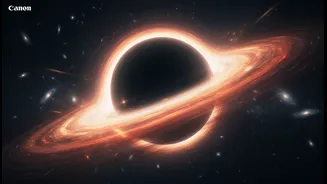
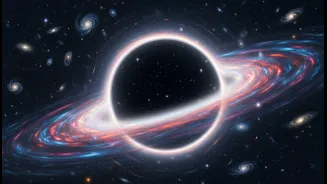
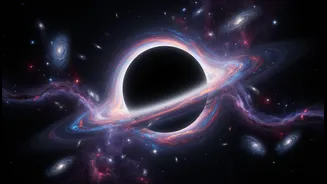
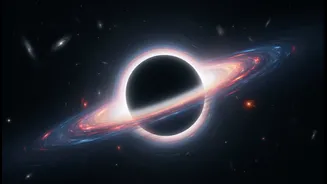
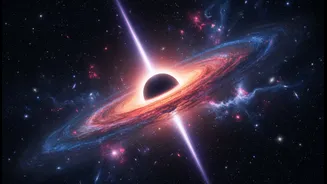
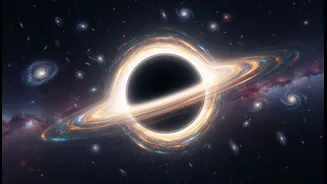
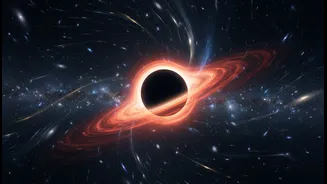
Supermassive black holes (SMBHs) are cosmic monsters, objects with gravity so intense that nothing, not even light, can escape. They are found at the heart of most large galaxies, including our own Milky Way. The puzzle isn't that they exist, but when
some of them appeared. Powerful telescopes like the James Webb Space Telescope (JWST) are spotting SMBHs that are already billions of times the mass of our sun in an era when the universe was less than a billion years old. This is the cosmological equivalent of finding a fully grown oak tree just days after the seed was planted. The timeline simply doesn’t seem to add up with our traditional understanding of how things grow in the cosmos.
A Universal Speed Limit
The conventional model for how black holes grow is straightforward: they eat. They pull in surrounding gas, dust, and stars, a process called accretion. But there’s a catch. As this material falls inward, it heats up and blazes with radiation. This outward-pushing light creates a form of pressure that counteracts gravity, effectively setting a speed limit on how fast a black hole can feed. This is known as the Eddington limit. For the earliest observed SMBHs to have grown from the remnants of a single dead star, they would have had to continuously feed at or even above this theoretical maximum for their entire existence, a scenario many scientists find improbable.
Light Seeds vs. Heavy Seeds
This growth problem has led to two competing theories about how the first giant black holes were born. The first is the 'light seed' model. In this scenario, the first generation of massive stars collapsed to form black holes around 100 times the mass of the sun. These 'seeds' would then gradually grow by accreting matter and merging with other black holes. But as noted, this is a slow process that struggles to explain the early giants. This has forced astronomers to consider a more radical idea: the 'heavy seed' model. This theory proposes that under the unique, pristine conditions of the early universe, enormous clouds of gas could have collapsed directly into a black hole, bypassing the star-formation phase entirely. This 'direct collapse' could create a seed black hole already weighing tens of thousands of solar masses, giving it a colossal head start.
New Clues from the Cosmic Dawn
The James Webb Space Telescope is revolutionizing this field by peering further back in time than ever before. It's discovering more of these head-scratching early SMBHs, sometimes in galaxies that seem far too small for them. Some discoveries show black holes that appear to be more massive than their entire host galaxy’s worth of stars, flipping the script on whether the galaxy or the black hole comes first. Other recent findings suggest a more complex picture, where some black holes grow in short, violent bursts, exceeding the normal feeding limits for brief periods. This 'super-Eddington' accretion might help bridge the gap, but it too requires specific conditions. Each new observation adds a piece to the puzzle, but a definitive answer remains elusive.