



Why Start With Bodyweight?
Using your own body as resistance is one of the most effective ways to begin strength training. It allows you to master proper form and movement patterns without the risk of injury that can come from adding weights prematurely. This approach helps build
confidence, improves balance and coordination, and targets not just the major leg muscles but also the smaller stabilising muscles around your joints. By focusing on slow, controlled repetitions, you build a solid base of muscular endurance and ensure that the right muscles are firing correctly, setting you up for safe and sustainable progress.
The Foundational Squat
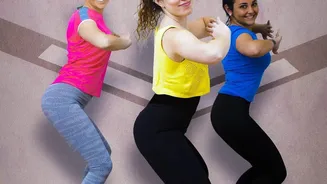
The bodyweight squat is a cornerstone of lower-body strength, targeting the quadriceps, hamstrings, and glutes. To perform it correctly, stand with your feet shoulder-width apart, with toes pointing slightly outward. Begin the movement by pushing your hips back as if you’re about to sit in a chair, keeping your chest up and back straight. Lower yourself until your thighs are at least parallel to the floor, ensuring your knees track in line with your toes and don't collapse inward. Drive through your heels to return to the starting position. Focus on a controlled descent and a powerful ascent.
Mastering The Lunge
Lunges are excellent for challenging each leg individually, which helps improve balance and correct strength imbalances. For a beginner-friendly reverse lunge, start by standing tall. Step one foot straight back, lowering both knees to form 90-degree angles. Your front knee should be directly over your ankle, and your back knee should hover just above the floor. Keep your torso upright and core engaged. Push through your front heel to return to the starting position. The reverse lunge is often easier on the knees for beginners than a forward lunge.
Activating Glutes with Bridges
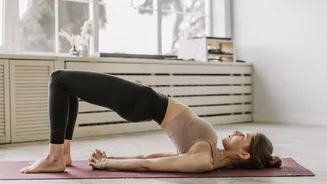
The glute bridge is a simple but powerful exercise for activating your glutes and hamstrings, muscles that are often underused in daily life. Lie on your back with your knees bent, feet flat on the floor about hip-width apart, and your heels a few inches from your glutes. Engage your core, then squeeze your glutes to lift your hips toward the ceiling until your body forms a straight line from your shoulders to your knees. Avoid arching your lower back. Pause at the top, squeezing your glutes, before slowly lowering your hips back down with control.
Don't Forget Your Calves
Strong calves are essential for stability and power in movements like walking and jumping. A simple calf raise is highly effective. Stand with your feet hip-width apart, holding onto a wall or chair for balance if needed. Slowly press through the balls of your feet to raise your heels as high as you can, feeling the contraction in your calves. Hold for a moment at the peak before slowly lowering your heels back down. Avoid rushing or bouncing; the magic is in the slow, controlled movement.
Putting It Together: Your First Routine
Consistency is more important than intensity when you're starting out. Aim to perform a leg workout 2-3 times per week, with at least one day of rest in between to allow your muscles to recover and grow. A great beginner routine would be to perform 2-3 sets of 10-15 repetitions for each exercise: squats, lunges (on each leg), glute bridges, and calf raises. Focus entirely on maintaining perfect form. If your form starts to break down, stop the set, rest, and continue when ready.