



September 9: The Epsilon Perseids Meteor Shower
While not as famous as its August counterpart, the September Epsilon Perseids meteor shower provides a wonderful opportunity for patient observers. This shower will be active from early to late September, but it is predicted to peak on the night of September 9.
With the new moon following shortly after on September 11, the sky will be conveniently dark, creating excellent viewing conditions with minimal moonlight interference. Expect a modest rate of about five to eight meteors per hour. For the best experience, find a location far from city lights, allow your eyes to adjust to the darkness, and look towards the constellation Perseus, which rises in the east after 8:00 PM. The best displays are often seen in the hours before dawn.
September 18: Venus Reaches Peak Brilliance
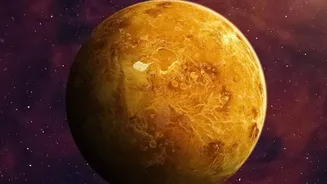
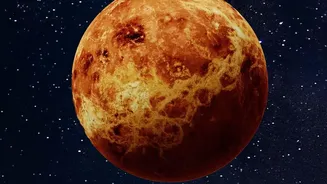
Venus will be a dominant and unmissable presence in the evening sky this month. On September 18, the planet will reach its brightest point for its 2026 evening appearance, shining at a dazzling magnitude of -4.8. This is so bright that it's one of the easiest celestial objects to spot, even from light-polluted urban areas. Look towards the western horizon shortly after sunset to catch this brilliant beacon. Interestingly, though it's at its brightest, a telescope would reveal Venus as a slender crescent. Its brightness is a combination of its relative closeness to Earth and its size, not how much of its face is illuminated.
September 23: The Autumnal Equinox
At 5:35 AM IST on September 23, the Northern Hemisphere will officially welcome the start of autumn with the autumnal equinox. This is the astronomical event where the Earth's axis is tilted neither toward nor away from the sun, resulting in nearly equal hours of daylight and darkness across the globe. For astronomy enthusiasts, the equinox is a welcome sign. It ushers in progressively longer nights, providing more time for stargazing and observing deep-sky objects. This period can also be favourable for witnessing auroras at higher latitudes, as the Earth's orientation can increase the chances of interaction with solar particles.
September 26: Neptune at Opposition
On the night of September 25-26, the distant ice giant Neptune will be at opposition. This means Earth will be positioned directly between Neptune and the Sun, making the planet appear at its brightest and closest for the year. Visible all night long in the constellation Pisces, Neptune will shine at a magnitude of +7.8. While it's not visible to the naked eye, you can spot it with a good pair of binoculars or a telescope, where it will appear as a tiny, distinctly blueish dot. The main challenge for viewing this year is that the full moon occurs on the same night, and its brightness may make it harder to spot the faint planet.
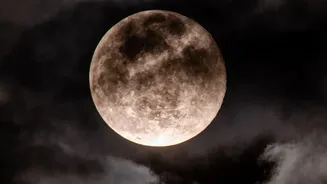
September 26: The Full Harvest Moon
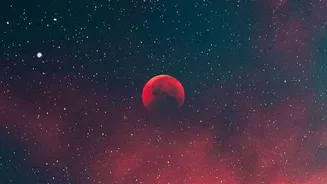
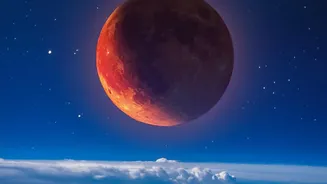
September’s full moon, which reaches its peak illumination at 10:19 PM IST on September 26, is famously known as the Harvest Moon. It earns this title by being the full moon closest to the autumnal equinox. This moon holds cultural significance in India, often aligning with the Pitru Paksha period for honouring ancestors. Around the equinox, the time between successive moonrises is shorter than usual, providing farmers with extra light during the crucial harvest season. Look for the moon rising in the east around sunset; it may appear with a striking orange or reddish hue when it's near the horizon due to its light passing through more of Earth's atmosphere. Keep an eye out for the planet Saturn, which will appear as a bright, star-like object near the Moon.