




What is Chandrayaan-4?
Chandrayaan-4 is India's next leap in lunar exploration, a robotic sample-return mission slated for launch around 2028. Building on the success of landing near the lunar south pole, ISRO's goal is no longer just to get to the Moon, but to land, collect
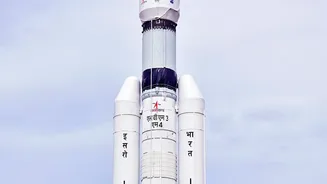
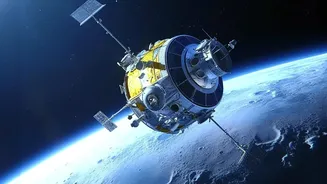
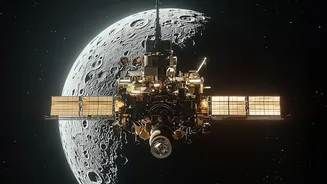
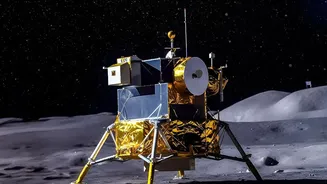
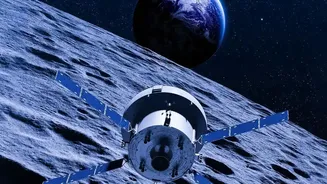
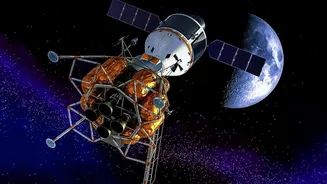
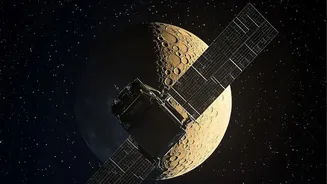
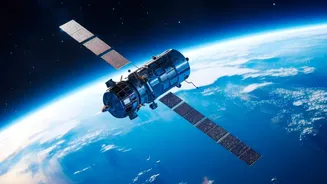
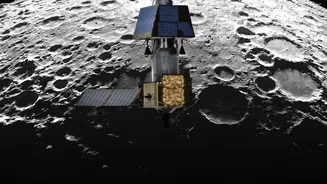
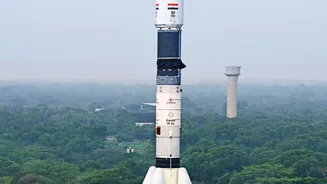
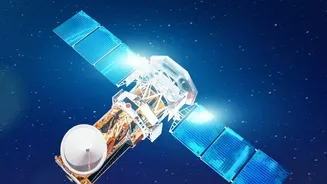
soil and rock samples, and bring them safely back to Earth for analysis. The mission is incredibly complex, requiring a level of technological sophistication that goes far beyond its predecessors. It will involve five separate modules: a propulsion module, a descender (lander), an ascender, a transfer module, and a re-entry module. Due to the total weight, the mission will require two separate heavy-lift LVM3 rocket launches to send all the components into orbit, where they will dock together before heading to the Moon. This in-space assembly is a major technological first for ISRO.
The Ultimate Challenge: A Round Trip to the Moon
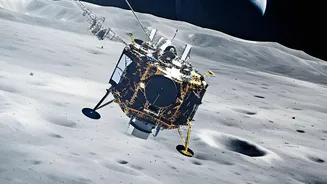
Returning samples from the Moon is exponentially harder than just landing there. The mission requires a perfect sequence of incredibly difficult manoeuvres. First, a soft and precise landing must be achieved. Then, a robotic arm will collect surface and sub-surface samples and place them into a container on the ascender module. This ascender must then launch itself off the lunar surface—a feat ISRO has never attempted before—and rendezvous with the transfer module waiting in lunar orbit. The samples must be transferred from the ascender to the re-entry module, another delicate docking operation. Finally, the re-entry module will travel nearly 400,000 kilometres back to Earth, surviving a fiery plunge through the atmosphere to deliver its precious cargo. Each step, from launching off the Moon to orbital docking and atmospheric re-entry, represents a monumental engineering challenge.
Joining an Exclusive Global Club
Successfully completing a lunar sample-return mission would place India in an elite group of spacefaring nations. To date, only the United States (through its crewed Apollo missions), the former Soviet Union (with its robotic Luna probes), and China (with its Chang'e missions) have managed to bring back lunar material. The Soviet Union was the first to do so robotically with Luna 16 in 1970, which returned about 101 grams of soil. China's recent Chang'e 5 and 6 missions have also been successful, returning kilograms of lunar regolith. By aiming to bring back around 2-3 kilograms of lunar material, Chandrayaan-4 is operating at a scale comparable to these modern missions. Achieving this goal would unequivocally demonstrate ISRO's mastery over a full cycle of planetary exploration, moving it from a nation that can reach other worlds to one that can interact with them and bring back their secrets.
More Than Just Moon Rocks
The scientific value of fresh lunar samples is immense. The samples brought back by the Apollo, Luna, and Chang'e missions revolutionized our understanding of the Moon's origin, its geological history, and the early solar system. However, all previous samples have come from a limited number of locations. Chandrayaan-4 aims to retrieve material from the Moon's south polar region, an area distinct from those previously visited. Scientists believe these polar samples could contain volatiles like water ice, which would be crucial for understanding the potential for in-situ resource utilization—using local materials to support future lunar bases. Studying these pristine samples in advanced labs on Earth, free from the weight and power constraints of a rover, allows for far more detailed analysis. This could answer fundamental questions about the Earth-Moon system and provide a ground truth for data collected by orbiters.
Paving the Way for Future Ambitions
Chandrayaan-4 is not just an endpoint; it is a crucial stepping stone for India's future in space. The technologies developed for this mission—such as automated rendezvous and docking, launching from another celestial body, and high-speed re-entry—are foundational for more ambitious projects. These are the very capabilities required for a future crewed lunar landing, a stated goal for India by 2040. By mastering the sample return, ISRO proves its capability to not only send astronauts to the Moon but also to bring them back safely. This mission solidifies ISRO’s position as a comprehensive space power, capable of end-to-end missions of the highest complexity. It transforms India from a participant in the global space race into a leader shaping its future direction.