





What Exactly Is the CAPSTONE Mission?
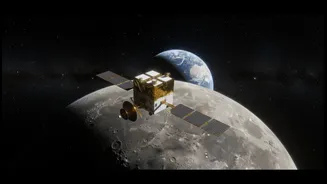
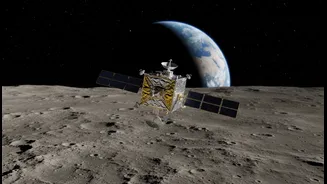
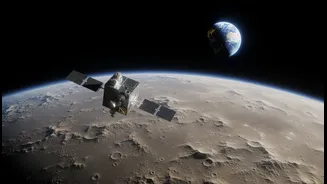
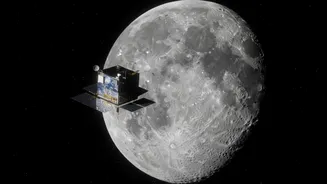
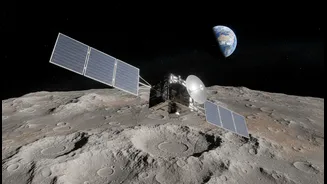
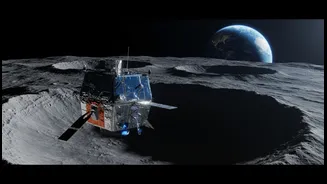
CAPSTONE is a microwave oven-sized satellite with a very long name and a vital job. Its full name is the Cislunar Autonomous Positioning System Technology Operations and Navigation Experiment. Launched in June 2022, this small but mighty CubeSat was designed
as a pathfinder for NASA's Artemis program. It is the first commercial and privately owned satellite to operate at the Moon, built and operated by Advanced Space and Terran Orbital for NASA. Its main goals are to test a unique lunar orbit and demonstrate a new way for spacecraft to navigate without constantly 'phoning home' to mission control on Earth. NASA officially concluded its activities with the highly successful mission in June 2026, though the spacecraft continues to operate as a testbed.
Why Is Its Orbit So Special?
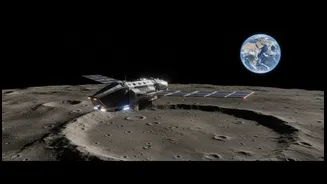
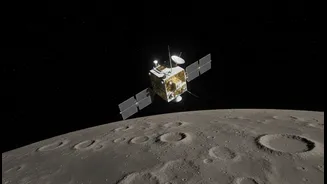
CAPSTONE is the first spacecraft to ever fly in a near rectilinear halo orbit (NRHO). Think of it as a very long, stretched-out egg shape that orbits from the Moon's North Pole to its South Pole. It comes as close as 1,600 kilometers to one pole and swings out as far as 70,000 kilometers from the other. This specific orbit is located at a precise balance point between the gravity of the Earth and the Moon. This gravitational sweet spot means the orbit is remarkably stable, requiring very little fuel for a spacecraft to stay there for a long time. This is the exact orbit planned for Gateway, the future lunar space station that will be a stepping stone for astronaut missions to the Moon's surface. CAPSTONE's job was to prove this orbit is as stable and reliable as computer models predicted.
What Is 'Autonomous Navigation'?
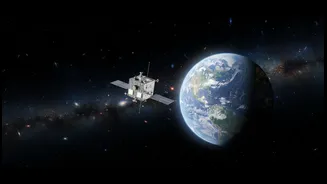
Essentially, it’s like giving a spacecraft its own GPS and a brain to use it. Autonomous navigation is the ability for a spacecraft to figure out its own position and direction without needing constant instructions from Earth. Historically, spacecraft have relied on the Deep Space Network, a system of massive antennas on Earth, to track their location and send course corrections. This process is effective but slow, especially as missions venture farther into space where communication delays can be significant. Autonomous systems allow a spacecraft to make real-time decisions, correcting its own course and reacting to its environment instantly.
How Does CAPSTONE Test This Technology?
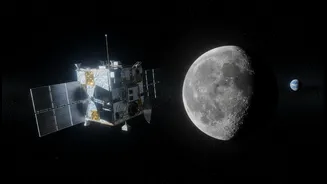
CAPSTONE is demonstrating a groundbreaking system called the Cislunar Autonomous Positioning System (CAPS). To test it, CAPSTONE communicates directly with another spacecraft already orbiting the Moon, NASA's Lunar Reconnaissance Orbiter (LRO). By sending signals back and forth with LRO, CAPSTONE's software can calculate its own position in space, much like how your phone uses multiple satellite signals to pinpoint your location. This spacecraft-to-spacecraft navigation is a first-of-its-kind demonstration at the Moon. The goal is to prove that future missions can navigate precisely using this peer-to-peer network, freeing them from total reliance on Earth-based tracking.
Why Is This a Big Deal for Future Moon Missions?
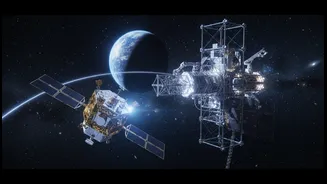
This technology is a game-changer for establishing a sustained human presence at the Moon. As the area around the Moon gets busier with Artemis missions, commercial landers, and international partners, we can't have every spacecraft waiting in a queue for directions from Earth. Autonomous navigation makes lunar operations more efficient, safer, and more scalable. Spacecraft can operate closer together, perform complex maneuvers like docking, and respond to unexpected issues without waiting for commands that have to travel hundreds of thousands of kilometers. By proving out both the NRHO orbit and autonomous navigation, the small CAPSTONE mission has retired significant risks for the multi-billion-dollar Gateway station and the entire Artemis architecture.