



A Flurry of New Discoveries
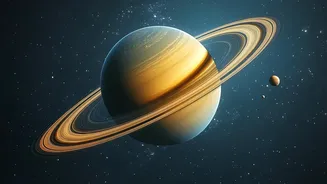
For years, Jupiter and Saturn were locked in a cosmic rivalry for the planet with the most moons. That race has decisively ended, for now. A cascade of recent discoveries has cemented Saturn’s lead. In March 2025, astronomers confirmed an astonishing
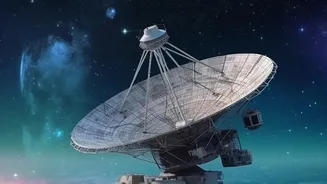
128 new moons. This was followed by the confirmation of another 11 in March 2026, bringing the official total to 293. To put that in perspective, Jupiter's count currently stands at just over 100. These discoveries didn't happen overnight. They are the result of years of painstaking work by international teams of astronomers using powerful ground-based telescopes like the Canada-France-Hawaii Telescope.
How to Find a Moon
Finding these tiny, distant worlds is a monumental challenge. The newest moons are only a few kilometres across and incredibly faint. Astronomers use a clever technique called 'shift and stack'. They take a series of images over time, digitally shifting them to follow the predicted path of a potential moon. By stacking these images, the faint signal of the moon is amplified, allowing it to emerge from the background noise of space. However, spotting a blip of light is only the first step. To be confirmed, an object must be tracked for months or even years to determine its full orbit and ensure it is truly gravitationally bound to Saturn. This confirmation process is why some moons announced recently were first observed in images dating back as far as 2004.
What Counts as a Moon?
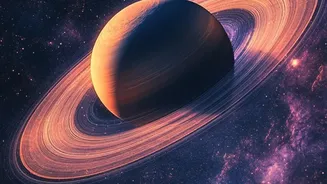
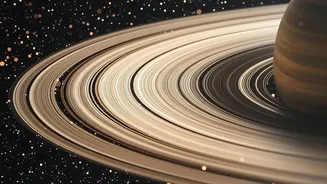
The official definition of a moon is a natural satellite orbiting a planet or smaller body. But there's a grey area. Saturn’s iconic rings are composed of countless icy particles, some hundreds of meters across, each orbiting the planet. These are generally not counted as true moons. There is no official size cutoff, but the working definition relies on an object being distinct and having a stable, confirmable orbit. Most of Saturn's newly found moons are classified as 'irregular'. These are thought to be captured objects, possibly asteroids or fragments from ancient collisions, that now follow distant, tilted, and often backward (retrograde) orbits around the planet. In contrast, 'regular' moons, like the massive Titan, likely formed alongside Saturn and have neat, circular orbits aligned with its equator.
The Hunt Is Far From Over
So, why is the count not final? Because our technology keeps getting better. The recent explosion in numbers is a testament to more sensitive telescopes and sophisticated data analysis techniques that can spot smaller and more distant objects than ever before. Astronomers are confident that what we've found is just the tip of the iceberg. Models suggest Saturn could host a population of hundreds, if not thousands, of small, undiscovered moons. As observing campaigns continue and future telescopes come online, it is almost certain that more will be added to the list. The final count is limited only by our ability to detect them.