




A Cosmic Definition Problem
Before we dive into the weirdness of Venus, let's get our terms straight. For us here on Earth, the concepts of a 'day' and a 'year' are simple. A day is one full rotation of our planet on its axis, giving us our 24-hour cycle of light and dark. A year is one full orbit
around the Sun, taking about 365.25 of those days. We intuitively understand this rhythm; it governs our calendars, our seasons, and our lives. The Earth spins relatively quickly while it travels along its vast orbital path. This relationship—many quick spins for every one long trip—is the standard for most planets in our solar system. But Venus, as it so often does, refuses to play by the rules.
Venus by the Numbers
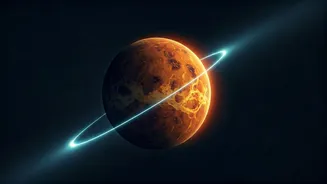
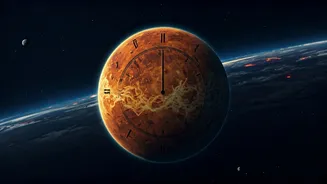
Here's where the brain-bending math comes in. A year on Venus—the time it takes to complete one orbit around the Sun—is approximately 225 Earth days. This makes it the fastest-orbiting planet after Mercury. Now, for the day. A 'sidereal day' is the time it takes for a planet to complete one full 360-degree rotation on its axis. On Venus, this single spin takes a mind-boggling 243 Earth days. That’s right: one full rotation (a Venusian day) takes longer than one full orbit (a Venusian year). It's like a carousel horse completing its trip around the entire ride before it has finished a single spin on its pole. This makes Venus the slowest-spinning planet in our solar system by a huge margin. For comparison, Jupiter, the fastest spinner, completes a rotation in under 10 hours.
Backward Spin and a Shorter 'Solar Day'
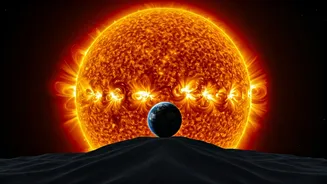
To add another layer of strangeness, Venus spins backward. Unlike Earth and most other planets, it has a retrograde rotation, meaning it spins clockwise on its axis. If you could stand on Venus (which you really, really can’t), you would see the Sun rise in the west and set in the east. This backward spin creates a curious effect on its 'solar day'—the time from one sunrise to the next. Because the planet is rotating in the opposite direction of its orbit, the sunrises happen more frequently than a full rotation would suggest. The result is a solar day of about 117 Earth days. So while a single *spin* is longer than a year, the time from sunrise to sunrise is shorter. It's still an incredibly long time to wait for morning coffee, but it helps solve part of the paradox. Even so, you'd only get about two sunrises per Venusian year.
Why the Slow, Backward Spin?
Scientists aren't entirely sure why Venus is the solar system's oddball spinner. The leading theories suggest a dramatic past. One idea is that Venus was struck by a massive asteroid or planetesimal early in its history, an impact so powerful it not only slowed its rotation to a crawl but completely flipped its orientation. Another theory involves a complex gravitational dance. Over billions of years, the Sun's powerful gravity tugging on Venus's incredibly thick atmosphere, combined with tidal forces from other planets, may have gradually slowed its spin and nudged it into this stable, sluggish, backward state. It's a planetary-scale tug-of-war that Venus lost, or perhaps, won in its own unique way.
Earth's Hellish Twin
This bizarre timekeeping is just one feature of Venus's extreme nature. Often called 'Earth's twin' due to its similar size and mass, the name couldn't be more misleading. The planet’s surface is a true vision of hell. The atmospheric pressure is over 90 times that of Earth's—equivalent to being nearly a kilometer deep in the ocean. The temperature hovers around a scorching 870°F (465°C), hot enough to melt lead, thanks to a runaway greenhouse effect. And its sky is permanently shrouded in thick clouds of sulfuric acid. The planet’s slow rotation likely contributes to this hellscape. With no rapid spin to drive weather patterns like Earth's, the heat is distributed more evenly across the entire planet, creating a uniform, inescapable furnace with no cool night side to offer relief.