





A Celestial Junkyard Above
Imagine a minefield where the mines are invisible, travel 10 times faster than a bullet, and are increasing in number every year. That’s the reality of Low Earth Orbit (LEO), the orbital band where most of our critical satellites live. Decades of space
activity have left behind a trail of spent rocket stages, defunct satellites, and countless fragments from past collisions. Experts estimate there are over a million objects larger than a centimetre circling the planet, each with enough kinetic energy to cripple or destroy a multi-crore satellite on impact. The number of collision avoidance manoeuvres ISRO has to perform is rising dramatically, from just a handful a decade ago to dozens in the last year alone, each one consuming precious fuel and shortening a satellite's operational lifespan.
India’s Proactive Digital Shield
Manually dodging this debris is no longer sustainable. It requires constant monitoring and ground control, a process that is slow and resource-intensive. In response, the Indian Space Research Organisation (ISRO) is advancing its capabilities through initiatives like Project NETRA (Network for Space Object Tracking and Analysis). This project serves as an early warning system, using a network of radars and telescopes to spot and track potential threats. The ultimate goal is to create a robust Space Situational Awareness (SSA) picture, allowing India to independently protect its assets without relying solely on data from foreign agencies. The headline technology—AI-powered thrusters—represents the next logical step: moving from simply seeing the threat to autonomously acting on it.
How AI Takes the Helm
While a fully autonomous on-board AI is the goal space agencies worldwide are working toward, the current system is a sophisticated partnership between ground and space. AI and machine learning algorithms are crucial for sifting through enormous volumes of tracking data to predict potential collisions, or conjunctions. These systems can analyse thousands of alerts and identify the handful that pose a genuine risk, a task that would overwhelm human operators. Once a high-risk threat is confirmed, the system calculates the most efficient avoidance manoeuvre. Instead of a large, fuel-guzzling burn, this often involves a tiny, precisely timed pulse from the satellite's thrusters to minutely alter its trajectory, ensuring it safely bypasses the debris. Automating this process reduces response time and the chance of human error in critical situations.
Protecting India's Eyes in the Sky
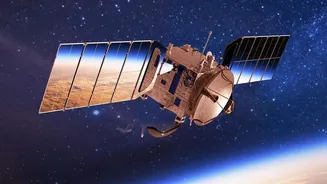
This technology is not just an engineering feat; it’s a crucial safeguard for India’s national infrastructure. India operates one of the world's largest constellations of civilian Earth-observation satellites. These are our eyes in the sky, providing essential data for everything from agricultural planning and water resource management to disaster response during floods and cyclones. They enable urban planning, mineral prospecting, and provide critical information for national security. Protecting this fleet of more than 50 operational satellites is paramount. An automated defence system ensures these services, which millions of Indians rely on, remain uninterrupted by the ever-growing threat from space junk.
A Leader in Sustainable Space
By developing these autonomous capabilities, India is positioning itself as a leader in sustainable space operations. As orbital congestion worsens with the launch of massive satellite mega-constellations, the ability to safely manage space traffic is becoming a critical global issue. ISRO's efforts, including its goal to achieve debris-free missions by 2030, signal a commitment to responsible space stewardship. This not only protects India's own significant investment in space but also contributes to the long-term viability of space exploration and commerce for all nations. This technological prowess enhances ISRO's operational maturity as it prepares for even more ambitious missions, including the Gaganyaan human spaceflight program.