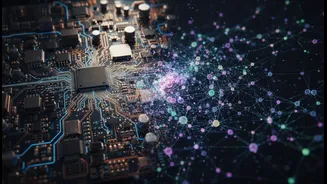









The New Reality: AI as a Coding Co-pilot
For decades, learning to code meant memorising syntax and mastering specific languages. Today, AI assistants like GitHub Copilot and other generative AI tools can produce functional code from a simple English prompt. This automates many of the repetitive
and routine tasks that once consumed a developer's day, such as writing boilerplate code, generating test cases, and even debugging simple errors. This shift doesn't make programmers obsolete; it changes their role. Instead of being the sole author of every line of code, a developer is increasingly becoming a guide or an editor, collaborating with an AI to achieve a goal faster and more efficiently. The focus is moving away from the manual act of writing code to the higher-level task of directing an AI to produce the right code.
Back to Basics: The Enduring Power of Logic
With AI handling the syntax, the true fundamentals of programming—computational thinking, logic, and problem-solving—have become more critical than ever. An AI can generate a script, but it doesn't understand the underlying business problem or the broader context. A human developer must still define the problem, break it down into logical steps, and evaluate whether the AI's output is a sound, secure, and efficient solution. This is why skills that are uniquely human, such as critical thinking, adaptability, and creativity, are now at a premium. The developer of the future won't be valued for their ability to write a perfect loop, but for their ability to analyse a complex system and devise an effective strategy to improve it, using AI as a powerful tool in their arsenal.
Redefining the 'Fundamental' Skill Set
As the old fundamentals reassert their importance, a new set of foundational skills is also emerging for the AI era. Chief among them is 'prompt engineering' or, more accurately, 'context engineering'. The ability to ask the right questions and provide an AI with precise context is what separates a useful output from a flawed one. Beyond communication with AI, data literacy has become essential. Since AI is driven by data, understanding how to clean, analyse, and interpret it is crucial for building and evaluating AI systems effectively. Furthermore, a solid grasp of AI and machine learning concepts is no longer a niche specialisation but a core competency for developers who want to integrate these powerful technologies into applications.
The Developer as Architect, Not Just Builder
The long-term career path for a programmer is shifting from that of a hands-on builder to a high-level architect. When AI can handle the construction of individual components, the human expert is needed to design the blueprint. This involves system design, understanding how different parts of a software ecosystem interact, and making crucial decisions about architecture that AI cannot make on its own. The most valuable professionals will be those who can think at a system level, oversee the work of AI, and ensure that the final product is robust, scalable, and aligned with strategic goals. This evolution demands a blend of deep technical knowledge and strong soft skills like communication and collaboration.
Future-Proofing Your Technology Career
For students and current professionals, navigating this new landscape requires a commitment to continuous learning and adaptation. Relying too heavily on AI to generate code without understanding it can lead to a decline in fundamental skills. Studies show that those who use AI to build comprehension—by asking it to explain code or clarify concepts—fare better than those who simply copy and paste. The path forward involves embracing AI as a collaborative partner rather than a replacement. Aspiring developers should focus on building a strong foundation in logic and systems thinking, while current engineers should upskill in areas like AI integration, data science, and ethical AI practices. The demand for tech professionals who can effectively harness AI remains strong, with projections indicating millions of new jobs will be created in the coming years.