




A Long Journey to an Ocean World
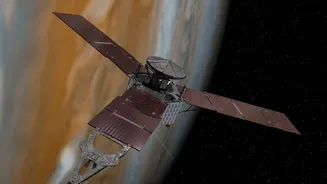
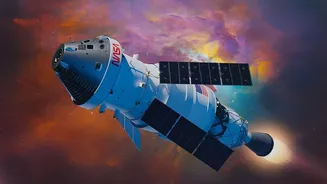
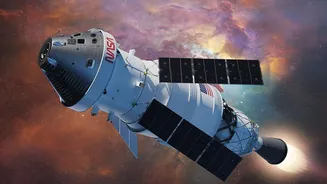
While the headline suggests an immediate deployment, the Europa Clipper's mission is a masterclass in cosmic patience. Having launched on October 14, 2024, the spacecraft is currently on a long and winding path to the outer solar system. It will take
five and a half years to reach its destination, using clever gravity assists from Mars in March 2025 and even a flyby of Earth in December 2026 to build up speed. The probe is scheduled to finally enter Jupiter's orbit in April 2030. Only then will its primary science mission—the “deployment” to inspect Europa—truly begin, with its first close flyby of the moon planned for the spring of 2031.
Why Europa Is So Compelling
So, why all this effort for one of Jupiter’s dozens of moons? Scientists are almost certain that beneath Europa’s frozen crust lies a global ocean of saltwater. Astonishingly, this subterranean sea may contain more than twice the amount of water found in all of Earth's oceans combined. Though it's smaller than our own moon, Europa has the three key ingredients considered essential for life: liquid water, essential chemical elements, and a source of energy. The energy doesn't come from the distant sun, but from the immense gravitational tug-of-war between Europa and the gas giant Jupiter, which kneads the moon's interior and likely keeps its ocean from freezing solid.
The Toolkit for an Icy Moon
Europa Clipper is the largest interplanetary spacecraft NASA has ever built, and it is packed with a powerful suite of nine science instruments designed to work in concert. These include high-resolution cameras to map the surface, a thermal imager to spot warm spots where the ocean might be close to the surface, and spectrometers to analyze the chemical composition of surface materials. One of the most critical tools is an ice-penetrating radar called REASON, which will probe the ice shell to confirm the ocean's existence and measure the shell's thickness. A magnetometer will also measure the magnetic field around Europa, which can reveal the ocean's depth and even its saltiness.
A Complex Cosmic Dance
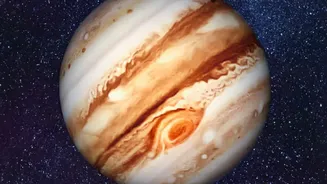
The spacecraft will not orbit Europa directly. Jupiter's magnetic field creates a zone of intense radiation that would quickly fry the probe's sensitive electronics. Instead, the Clipper will enter a long, looping orbit around Jupiter itself. From there, it will perform nearly 50 carefully orchestrated, high-speed flybys of Europa over several years. During these brief encounters, it will dive in for data collection, sometimes swooping as low as 16 miles (25 kilometers) above the fractured, icy surface before retreating to the relative safety of its wider orbit around Jupiter. This strategy maximizes science while minimizing radiation exposure.
Is It Looking for Aliens?
NASA is very clear on this point: Europa Clipper is not a life-detection mission. Its primary goal is to determine if Europa is habitable—that is, if it has the right conditions to support life as we know it. The mission will hunt for the building blocks of life, like organic molecules, especially if it can fly through and sample one of the water vapor plumes that are believed to erupt from the moon's surface. While its instruments might detect complex molecules that hint at biological processes, they aren't designed to find a definitive smoking gun like a living microbe. Instead, the Clipper's findings will pave the way for a future mission that could one day land on the ice and search for life directly.