



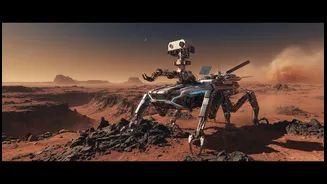


Beyond the Six-Wheeled Rover
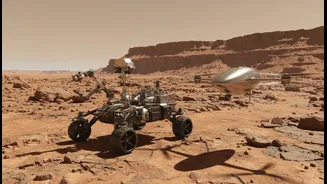
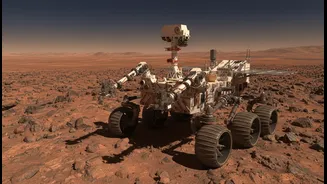
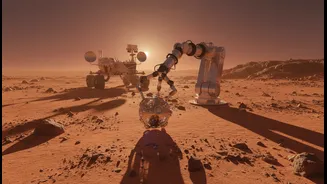
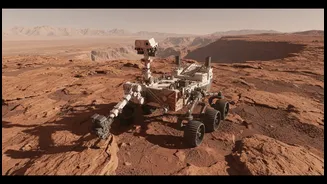
For decades, our vision of Mars exploration has been shaped by six-wheeled rovers like Curiosity and Perseverance. These car-sized labs have trundled across the Martian plains, delivering groundbreaking science. However, their design, while reliable,
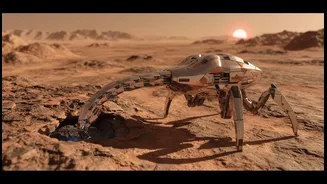
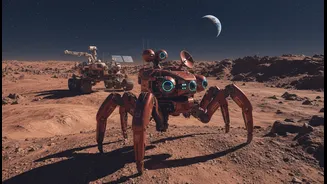
keeps them from accessing steep crater walls, deep canyons, or potential cave networks where some of the most compelling scientific discoveries may lie. To overcome this, NASA and its partners are looking beyond the traditional wheel. They are investing in a new class of robots designed for extreme mobility and unprecedented autonomy, aiming to unlock parts of Mars that have been unreachable until now.
Agility Through Innovation
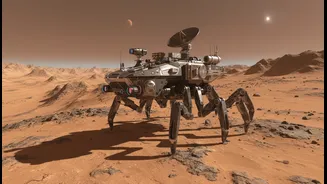
The future of Martian mobility looks far more diverse. One promising prototype is ERNEST (Exploration Rover for Navigating Extreme Sloped Terrain), a four-wheeled rover that can lift its wheels independently and use an active suspension system to crawl over large obstacles that would stop current rovers in their tracks. Recent tests in the California desert showed ERNEST can autonomously navigate miles of difficult terrain, even mimicking a squirming motion to free itself from sandy traps. Other concepts take inspiration from nature. Snake-like robots, such as the Exobiology Extant Life Surveyor (EELS), are being designed to slither into tight spaces. While initially conceived for the icy moons of Saturn, its adaptable, self-propelled segmented design makes it a candidate for exploring Martian caves or polar ice caps.
A Leap in Robotic Intelligence
Agility is only half the equation; the next generation of robots must also be smarter. The significant time delay for commands traveling between Earth and Mars makes real-time control impossible. Future robots will need enhanced autonomy to make their own decisions. NASA is using artificial intelligence, including reinforcement learning, to train robots like ERNEST to assess their environment and choose the best path forward without human intervention. This allows the rover to travel farther and faster. In recent tests, ERNEST drove at speeds much faster than Perseverance by relying on its onboard AI. This onboard decision-making is crucial for enabling more ambitious exploration and reducing the reliance on ground control for every move.
The Power of the Swarm
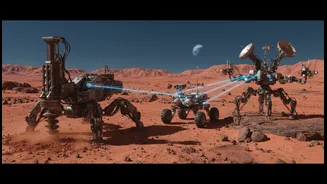
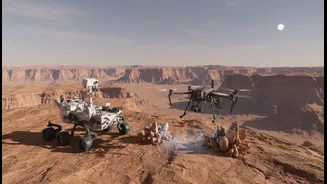
Another revolutionary concept is the use of robotic swarms. Instead of a single, large, expensive rover, missions could deploy a team of smaller, collaborating robots. NASA's CADRE (Cooperative Autonomous Distributed Robotic Exploration) project is a prime example. While its first mission is a technology demonstration on the Moon, the principles are directly applicable to Mars. A trio of suitcase-sized rovers will work together, communicating with each other to map an area in 3D. They will autonomously elect a leader, distribute tasks, and gather data from multiple points simultaneously—a feat impossible for a lone explorer. This approach not only provides richer data but also offers more resilience; if one robot fails, the mission can continue.