

The Solar System's Deep-Freeze Attic
Think of the Kuiper Belt as our solar system’s deep-freeze attic. It’s a donut-shaped region that begins near Neptune's orbit, around 30 times farther from the Sun than Earth is, and stretches outward into the darkness. This frigid expanse is populated
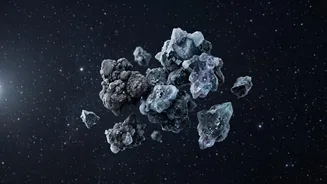
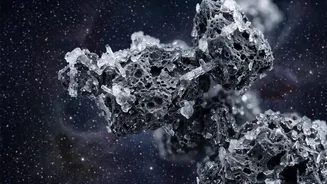
by hundreds of thousands of icy bodies, from dwarf planets like Pluto to smaller rocky and frozen objects that are leftovers from the formation of our planetary system billions of years ago. Because they've been preserved in the cold, these Kuiper Belt Objects (KBOs) are like time capsules. Studying them, and even the dust they produce, gives scientists clues about the raw materials that built our world.
A Student-Built Dust Buster
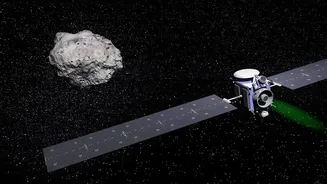
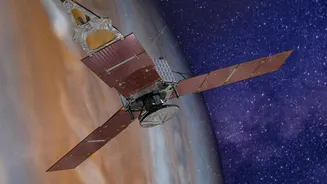
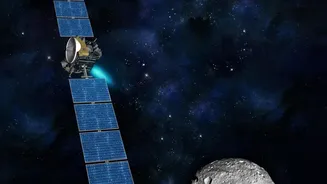
The hero of this story is a surprisingly humble instrument aboard the New Horizons spacecraft called the Venetia Burney Student Dust Counter (SDC). As its name suggests, it was designed and built by students at the University of Colorado Boulder, making it the first student-led instrument on a NASA planetary mission. The SDC isn't a fancy camera. It’s essentially a cake-pan-sized detector mounted on the outside of the spacecraft. As New Horizons speeds through space, any microscopic dust grain that hits the detector's thin film creates a tiny electrical signal. From this signal, scientists can determine the particle's mass and get a count of how much dust is in that specific part of space. It’s the most distant operating dust detector in history, giving us our first-ever direct taste of the environment beyond Pluto.
Why the Sample Size Is So Small
The headline mentions a 'small sample of grains', and it's a crucial point. Space is, by its very nature, incredibly empty. Even in a 'dusty' region like the Kuiper Belt, the distance between individual particles is immense. The SDC instrument is only about the size of a cake pan, while it travels through a region billions of kilometres wide. Catching even a few dozen grains is statistically significant because of the vast area the spacecraft covers over several years. Each impact is a rare event. The challenge isn’t a flaw in the study; it’s an inherent reality of trying to physically sample an environment so expansive and diffuse.
The Science of Drawing Big Conclusions
So, how can scientists make bold claims from just a handful of dust particles? It comes down to comparing real-world data against established models. Before New Horizons reached the Kuiper Belt, scientists had created sophisticated models predicting how much dust should be there. These models were based on everything we knew about gravity, radiation pressure from the Sun, and the estimated number of KBOs colliding and shedding material. When the SDC's actual measurements came in consistently higher than the models predicted, it was a major red flag. It’s like expecting a light drizzle based on the weather forecast but feeling a steady rain. Even a few drops tell you the forecast was wrong. The discrepancy forces scientists to ask what their models are missing.
A Dustier-Than-Expected Discovery
The key finding from the SDC is that the Kuiper Belt is significantly dustier at its far edges (between 45 and 55 times Earth's distance from the Sun) than our best models predicted. Existing science suggested that the main belt should start thinning out around 50 astronomical units (AU), leading to less dust. But New Horizons found the opposite; the dust levels remained high, and even grew. This suggests something is actively creating more dust out there. The most likely cause is that there are more KBOs in that region than previously thought, leading to more frequent collisions that generate fresh dust.
Rewriting the Map of Our Solar System
This unexpected dustiness has huge implications. It provides strong evidence that the Kuiper Belt doesn't just end abruptly. Instead, it might extend much farther than we thought, perhaps out to 80 AU or even beyond. Some scientists even speculate this could be evidence of a second, more distant belt of objects we haven't seen yet. This growing body of evidence, supported by new telescope discoveries of distant KBOs, is forcing astronomers to redraw the map of our solar system's outer limits. These tiny dust grains, collected one by one, are telling us that the story of our cosmic neighbourhood is far from complete.