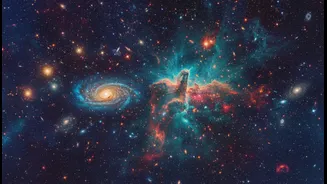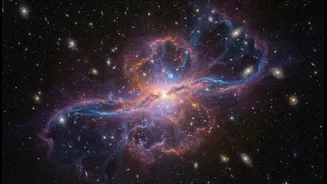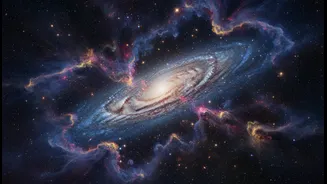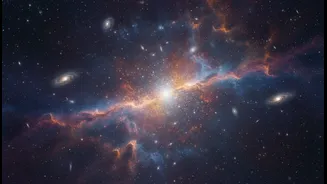




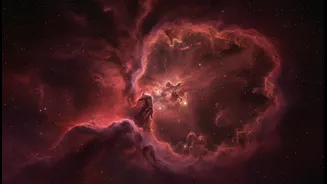


An Enduring Icon in Orbit
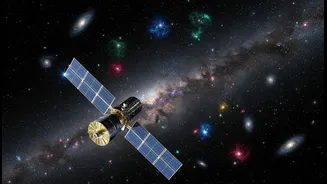
Launched in 1990, the Hubble Space Telescope fundamentally changed humanity's relationship with the universe. For the first time, people saw crystal-clear images of distant galaxies, nebulae, and star clusters. These weren't just scientific data points;
they were breathtaking portraits of the cosmos that captured the public imagination. From helping to measure the age of the universe to confirming the existence of supermassive black holes, Hubble became arguably the most productive scientific instrument ever built. Its discoveries have led to thousands of scientific papers, reshaping our understanding of everything from planet formation to the accelerating expansion of the universe. More than a tool for astronomers, Hubble became a cultural icon, its images decorating classrooms and inspiring a generation of scientists and stargazers.
Recent Glimpses of Cosmic Marvels
Even with newer telescopes on the scene, Hubble’s mission of discovery is far from over. In July 2026, NASA released a stunning new image of Messier 3, a colossal globular cluster containing over 500,000 stars. This ancient collection of stars, shining in brilliant reds, whites, and blues, acts as a time capsule, helping scientists piece together the Milky Way’s history. Earlier in the year, Hubble uncovered a new type of astronomical object nicknamed “Cloud-9,” a starless cloud of gas and dark matter that could be a relic from the early universe. Other recent observations include a spectacular view of the LH 95 stellar nursery, where thousands of young stars are just beginning their life cycle, and a surprising detection of ultraviolet light from a galaxy that existed just 1.4 billion years after the Big Bang, a feat once thought impossible.
A Resilient Pioneer
Operating a 36-year-old spacecraft in the harsh environment of space is not without its challenges. Over the years, Hubble has faced technical hurdles, most notably with its gyroscopes—devices that allow it to point with precision. In mid-2024, after one of its three remaining gyros began returning faulty data, NASA made the decision to transition Hubble to a one-gyro operational mode. This long-planned contingency mode was designed more than 20 years ago to prolong the telescope's life. While it means the observatory takes slightly longer to slew to new targets, it has a minimal effect on the quality of the science data it collects. This engineering feat ensures Hubble can continue its scientific mission well into the next decade, a testament to the ingenuity of the teams that support it.
A Powerful Partnership with Webb
The launch of the James Webb Space Telescope (JWST) in 2021 didn't make Hubble obsolete; it gave it a powerful partner. The two observatories are designed to be complementary, not competitors. While Webb is optimized to see the universe in infrared light—perfect for peering through cosmic dust and observing the most distant galaxies—Hubble’s strength lies in ultraviolet and visible light. Together, they provide a multi-wavelength view of the cosmos that neither could achieve alone. For example, when studying a star-forming region, Hubble can reveal the brilliant glow of young, hot stars, while Webb can pierce through the dust clouds to show the infant stars still forming within. This collaborative approach allows scientists to build a more complete picture of cosmic events.