


The Official Rulebook
The entire formal process hinges on a single sentence in Article 97 of the UN Charter. It states that the Secretary-General “shall be appointed by the General Assembly upon the recommendation of the Security Council.” For decades, this meant the selection
was held entirely behind closed doors, with the Security Council presenting a single candidate to the 193-member General Assembly for what was essentially a rubber-stamp approval. While the General Assembly has never rejected the Council's recommended candidate, its role has become more substantial in recent years. The term is customarily five years and can be renewed once.
The Security Council's Decisive Role
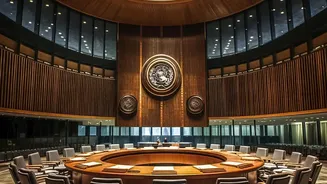
The real power lies with the 15-member Security Council, and more specifically, its five permanent members (P5): China, France, Russia, the United Kingdom, and the United States. For a candidate to be recommended, they must secure at least nine affirmative votes from the Council, with no veto from any of the P5. This veto power means that any of the five major powers can block a candidate, ensuring that the eventual nominee is not strongly opposed by any of them. This gives the P5 disproportionate influence over the selection and, by extension, the UN's priorities. The process often reflects the geopolitical tensions of the day.
Straw Polls and Secret Ballots
To gauge support and build consensus, the Security Council conducts a series of informal secret ballots known as 'straw polls'. In these polls, members vote to 'encourage', 'discourage', or express 'no opinion' on each candidate. As the process continues, later rounds use colour-coded ballots that distinguish the votes of the permanent members from the ten elected members. A 'discourage' vote on a red ballot from a P5 member is effectively a veto threat, signaling to a candidate that their path to the top job is blocked. This method allows the Council to narrow the field until a candidate emerges who can command sufficient support without attracting a veto.
Unwritten Rules and Traditions
Beyond the formal rules, several powerful informal conventions shape the race. The most significant is the principle of regional rotation, an unwritten understanding that the post should rotate among the different geographical regions of the world. While this is not a strict rule and has been disrupted, it remains a major factor in determining which region's turn it is to put forward candidates. There is also a long-standing tradition that nationals of the P5 countries are not eligible for the post. Additionally, there have been growing calls to appoint a woman to the role for the first time in the UN's history.
A Push for Greater Transparency
For much of its history, the selection process was shrouded in secrecy. However, starting with the 2016 selection of António Guterres, significant reforms pushed for by the General Assembly and civil society groups have introduced new levels of openness. General Assembly resolution 69/321 called for the process to be initiated by a joint letter from the presidents of the General Assembly and the Security Council, inviting member states to nominate candidates. Candidates now submit vision statements and participate in live-streamed, public interactive dialogues with the General Assembly, where they answer questions from member states and the public. This has made the race more transparent, even though the final decision still rests within the closed doors of the Security Council.