


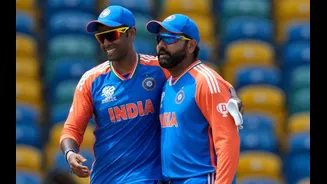
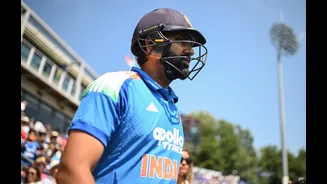
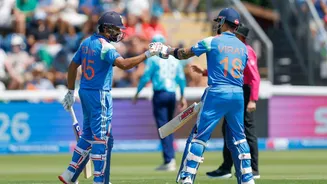
The Knockout Conundrum
India’s journey in ICC tournaments from 2014 to 2024 is a story of 'so near, yet so far'. The team consistently excelled in the group stages, often entering the knockouts as firm favourites, only to falter at the final hurdles. This pattern repeated across
formats: the 2014 T20 World Cup final, the 2015 and 2019 ODI World Cup semi-finals, the 2017 Champions Trophy final, and the finals of the 2021 and 2023 World Test Championships. Even in the 2023 ODI World Cup on home soil, India won ten games on the trot before losing the all-important final to Australia. This repeated failure to cross the last hurdle pointed towards a psychological barrier as much as a tactical one, earning them the unfortunate tag of 'chokers' in crucial, high-pressure games.
A Brittle Top Order Under Pressure
A recurring theme in these knockout losses was the failure of India’s formidable top-order batting. While stalwarts like Virat Kohli and Rohit Sharma dominated bilateral series, they often couldn't produce their match-winning best when it mattered most in an ICC knockout game. In the 2017 Champions Trophy final, India was reduced to 33/3. In the 2019 World Cup semi-final, the top order collapsed to 5/3, a setback from which the team never fully recovered. Rohit Sharma himself acknowledged this trend, noting that the team often lost the game in the initial phase and needed to prepare for worst-case scenarios, like being 10/3. This over-dependence on the top two or three batters meant that on the rare day they failed together, the middle order was left with too much to do against world-class bowling attacks.
Searching for the Perfect Balance
Throughout this decade, India grappled with team selection and finding the right combination for big tournaments. Key issues included the long-standing search for a reliable number four batsman, the absence of a pace-bowling all-rounder in the mould of Hardik Pandya when he was injured, and questionable selections for specific conditions. For instance, analysts questioned the one-dimensional nature of the batting lineup, which lacked left-handers in the top order, making it predictable for opposition captains. Decisions like not playing Ravichandran Ashwin in the 2023 WTC final on a turning pitch, or persisting with out-of-form players, were heavily scrutinised and pointed towards a lack of a clear 'Plan B' when the initial strategy didn't work.
Leadership and the Weight of Expectation
The captaincy transitioned from the calm demeanour of MS Dhoni to the passionate aggression of Virat Kohli, and then to the strategic acumen of Rohit Sharma. While all three achieved immense success, none could break the ICC trophy jinx during this period. Kohli led India in four ICC events without a title win. The immense pressure from a billion fans and a hyperactive media landscape cannot be understated. This 'weight of a billion dreams' often seemed to translate into a palpable tension on the field during knockout games. Players who performed fearlessly in the IPL and bilateral series appeared shackled and hesitant when the stakes were highest, leading to uncharacteristic errors in clutch moments. The pressure to not lose seemed to outweigh the freedom to win.

![[WATCH] 'Hookah pee ke aa raha hoon' - MS Dhoni's candid remark to Rishabh Pant goes viral](https://g-mob.glance-cdn.com/public/fc/image/TDfS7ES_jTn0.webp)