






Your desk job is meant to be comfortable, but it might be the source of nagging aches and stiffness. The human body wasn't designed for prolonged sitting, which can impact joint health. Simple, consistent changes can make a world of difference.
Why Sitting Is a Silent Strain
Our bodies
are built for movement. When you sit for hours, a few things happen that lead to discomfort. Blood flow decreases, muscles that are meant to support you can weaken, and joints can stiffen. Think of your joint cartilage like a sponge; it needs the compression and release of movement to soak up nutrients and stay healthy. Prolonged stillness removes this natural cycle, leading to stiffness, especially in the hips, knees, and spine. This isn't about a single injury, but the cumulative effect of being static, which can strain muscles, ligaments, and spinal discs over time.
The Key Problem Areas: Hips and Spine
The most common complaints from desk workers often trace back to the hips and lower back. Sitting holds your hips in a constant state of flexion, causing the muscles at the front of your hips (the hip flexors) to become short and tight. This tightness can pull on your pelvis, contributing to lower back pain. Meanwhile, slouching in a chair puts extra pressure on the discs in your lumbar spine. This combination of tight hips and a strained lower back creates a painful cycle that can affect your entire posture, leading to that familiar stiffness when you finally stand up.
Beyond the Back: 'Tech Neck' and Shoulders
The strain doesn't stop at your lower back. Leaning forward to look at a computer screen causes your head to drift forward, a posture commonly known as 'tech neck'. For every inch your head moves forward, the load on your neck and upper back muscles effectively doubles. This forces the muscles in your neck and shoulders to work overtime just to hold your head up, leading to fatigue, tension, and even headaches. Over time, the chest muscles can tighten, pulling the shoulders forward into a rounded position, further weakening the muscles of the upper back.
Your First Defence: An Ergonomic Workstation
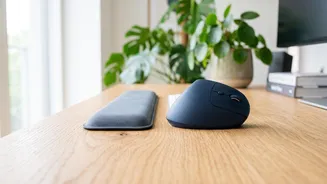
Preventing pain starts with a proper setup. Adjust your chair so your feet are flat on the floor and your knees are at or just below hip level. Your chair should have lumbar support to maintain the natural curve of your lower back; a small pillow or rolled towel can work in a pinch. Position your monitor an arm's length away, with the top of the screen at or slightly below eye level to keep your neck neutral. Your keyboard and mouse should be close enough that your elbows can stay near your body at roughly a 90-degree angle, with relaxed shoulders.
Simple Stretches You Can Do at Your Desk
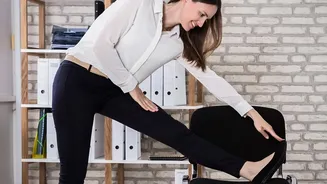
Integrating simple movements can counteract stiffness. Try these throughout the day. For your neck, gently perform 'chin tucks' by pulling your chin straight back as if making a double chin. For your spine, try a seated 'cat-cow': inhale as you arch your back and look up, then exhale as you round your spine and tuck your chin. To target your hips, the 'figure 4' stretch is excellent: while seated, cross one ankle over the opposite knee and gently lean forward. Finally, for your upper back, squeeze your shoulder blades together and hold for a few seconds to activate underused muscles.
The Power of Micro-Movements
A perfect ergonomic setup and a few stretches are great, but the most crucial habit is frequent movement. The goal is to interrupt prolonged sitting. Set a timer to remind yourself to stand up, stretch, or walk for a few minutes every 30 to 60 minutes. Taking a brisk walk during a phone call, standing up during meetings, or simply walking to get a glass of water helps restore circulation and gives your joints and muscles a necessary break from static posture. Consistency is more important than intensity; these small but regular 'movement snacks' have a powerful cumulative effect on joint health.