




More Than Just an Eye in the Sky
For decades, the primary job of a satellite was to be a passive observer or a simple relay station: capture an image, bounce a signal, and send raw data back to Earth for processing. That model is quickly becoming obsolete. The modern space race isn't
just about getting to orbit; it's about deploying smart, autonomous, and secure systems in space. This is where India, through its space agency ISRO and a growing private sector, is making a strategic pivot. By integrating AI and quantum principles, the country is planning to turn its satellites from simple data collectors into active, decision-making platforms in orbit. This shift promises to enhance everything from agricultural monitoring and disaster management to military communication and financial security.
AI: The Onboard Brain for Smarter Satellites
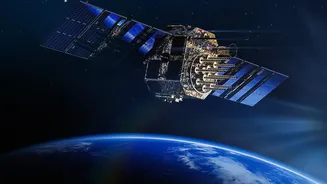
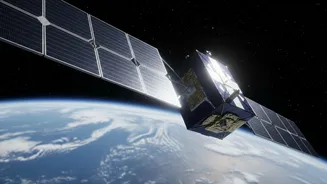
Artificial intelligence is set to become the onboard brain for India's future satellite fleets. Instead of beaming massive amounts of raw data to ground stations, which creates delays and requires immense bandwidth, AI will enable satellites to process information directly in space. This is known as on-board processing or edge computing. For example, an Earth observation satellite could use AI to analyze agricultural land, identify crop diseases, and send down a concise report rather than terabytes of imagery. This capability dramatically speeds up decision-making for everything from disaster response, where real-time information is critical, to urban planning. AI will also play a crucial role in autonomous operations. This includes enabling satellites to independently navigate, avoid space debris, and perform self-health checks to predict and prevent system failures, extending their operational lifespan.
Quantum: The Key to Unbreakable Communication
While AI provides the intelligence, quantum technology promises to deliver unprecedented security. The primary application for India's next-gen satellites is Quantum Key Distribution (QKD). This technology uses the principles of quantum physics to create encryption keys that are theoretically unhackable. Any attempt to eavesdrop on a quantum communication channel would disturb the quantum state, immediately alerting the communicating parties. The Indian Space Research Organisation (ISRO) has already successfully demonstrated free-space QKD over a distance of 300 meters, a critical step toward implementing Satellite-Based Quantum Communication (SBQC). The goal is to establish secure communication links between ground stations, between satellites, and with other countries, covering distances of over 2,000 kilometers. This capability is vital for protecting sensitive military, financial, and governmental data from future threats, including those posed by quantum computers.
India's National Mission and Global Position
These efforts are not happening in a vacuum. They are a core part of India's National Quantum Mission (NQM), a major government initiative launched in 2023 with a budget of over ₹6,000 crore (around $730 million) to be used through 2031. This mission aims to establish India as a global leader in quantum technologies by developing indigenous capabilities in quantum computing, communication, and sensing. By fostering a domestic ecosystem of startups, academic institutions, and industry players, India is working to reduce its dependence on foreign technology. This strategic push, combined with a 2023 space policy that encourages private sector innovation, positions India not just as a launch provider but as a developer of some of the world's most advanced space systems. The fusion of AI's analytical power with quantum's security shield will be a defining feature of the country's growing influence in the global space economy.