







The New Martian Gold Rush
For decades, reaching Mars was a monolithic goal pursued by national space agencies with colossal budgets. Today, the landscape is radically different. A new era of space exploration is dawning, driven by public-private partnerships (PPPs). NASA is increasingly
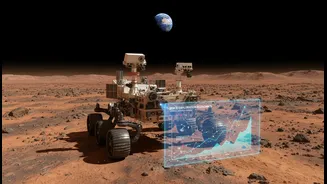
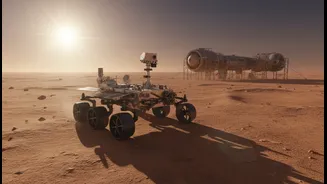
acting as an anchor customer, leveraging commercial innovation to achieve its deep-space ambitions. This model has already proven successful in lowering the cost of reaching low-Earth orbit and the Moon. Now, NASA is extending this strategy to the Red Planet, recently announcing a partnership with Relativity Space for an uncrewed science mission in 2028. The plan is simple: NASA provides the scientific instruments, and the private partner handles the rocket, spacecraft, and operations. This approach, NASA says, is a "force multiplier for science," allowing for more frequent missions at a reduced cost to the taxpayer.
The Promise of Partnership
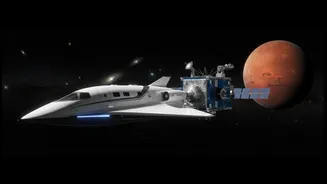
The appeal of the PPP model is undeniable. Private companies, driven by competition and streamlined development, can often build and launch hardware for a fraction of what it costs a government agency. SpaceX's Falcon 9 rocket, for example, has drastically reduced launch costs compared to legacy government-funded rockets. By purchasing services rather than owning and operating all the hardware, NASA can focus its resources on cutting-edge research and mission objectives. This strategy not only saves money but also fosters a competitive commercial space ecosystem, accelerating technological progress. For missions to the International Space Station and the Moon, this has been a game-changer, enabling a faster mission cadence and spreading the financial burden. The hope is to replicate this success for the far more ambitious goal of Mars.
The Mars Reality Check
However, Mars is not the Moon. A mission to the Red Planet is an undertaking of a completely different magnitude of complexity and risk. The journey is longer, the environment is harsher, and the margin for error is virtually nonexistent. Unlike missions in our cosmic backyard, a Mars crew cannot be easily rescued. This is where the mantra of "lower cost" runs into the harsh reality of risk. The extreme challenges of a Mars mission include prolonged exposure to cosmic radiation, the physiological effects of microgravity, and the psychological stress of isolation. Furthermore, the Martian environment itself is perilous, with toxic soil and a thin atmosphere that offers little protection. Every system—from life support to landing hardware—must function flawlessly for years. In this high-stakes environment, the pressures of a commercial, fixed-price contract could clash with the rigorous, often expensive, safety culture that NASA has cultivated over decades.
A Culture of Caution vs. Speed
At its core, the issue is a potential misalignment of incentives. Commercial entities are incentivized to innovate rapidly and control costs to remain profitable and competitive. Government agencies like NASA, on the other hand, operate under a mandate where safety and mission assurance are paramount, often leading to slower, more methodical, and more expensive processes. For lower-risk missions, these two cultures can complement each other well. But research suggests that for the highest-risk missions—like a human expedition to Mars—the cost savings from using industry partners may not be as significant, precisely because the required safety and reliability standards drive up complexity and expense regardless of who builds the hardware. There is a risk that in a competitive environment, companies might be pressured to cut corners or underestimate the immense challenges of ensuring system reliability over a multi-year deep space mission. A single high-profile failure could erode public confidence and jeopardize the entire future of human space exploration.
Forging a Safer Path Forward
This doesn't mean the public-private model for Mars is doomed. In fact, given the immense cost, it may be the only viable path forward. However, success requires a new framework of shared responsibility. It means establishing clear, non-negotiable safety standards for deep space missions from the outset, moving beyond the different rules that currently govern various providers. It involves transparent data sharing between NASA and its commercial partners to learn from every test and anomaly. Finding the ideal balance, where the government does not relinquish too much control and the private sector does not assume an untenable level of risk, is crucial. For a human Mars mission, fault tolerance must be designed in from the start, often requiring multiple layers of redundancy that add cost and weight—a difficult reality for a budget-driven program.