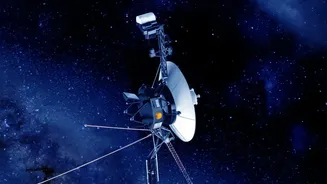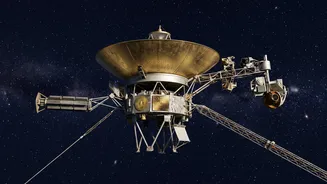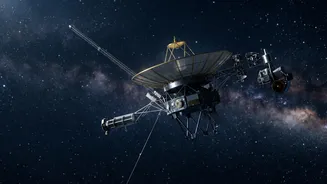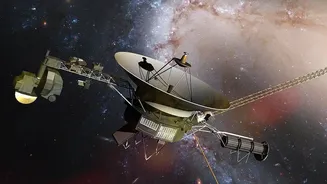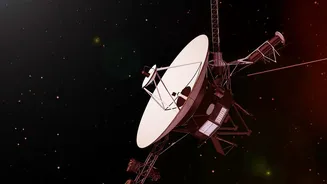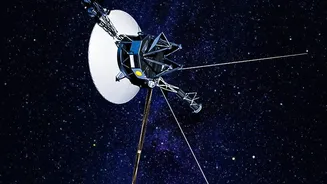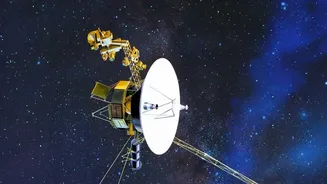





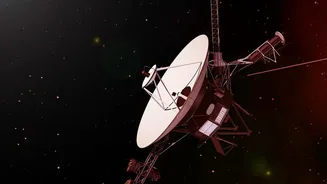
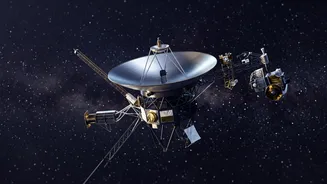
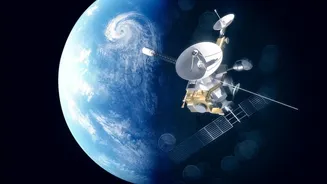
Humanity’s farthest-flung object, the Voyager 1 spacecraft, gave its creators a scare last month by falling silent. Now, with contact restored, NASA engineers are working to understand what happened and what it means for the legendary mission.
A Worrying Silence from Deep Space
For two
days in mid-October, there was nothing. On October 18 and 19, NASA’s Deep Space Network, a global array of giant antennas, listened for Voyager 1's signal during scheduled check-ins and heard only silence. It was a nail-biting period for the mission's engineers. The probe, now nearly 26 billion kilometres away, is so distant that a round-trip communication takes about two days. Remarkably, before the ground team could even send troubleshooting commands, Voyager 1’s signal reappeared on its own on October 20. The team has been in contact with the spacecraft since, but the unexpected outage has them on high alert.
Diagnosing a 49-Year-Old Patient
So, what happened out there in the interstellar void? Investigations are ongoing, but the team has a primary clue. It appears the spacecraft’s onboard fault-protection system kicked in automatically. Engineers have determined that one group of the probe's maneuvering thrusters went offline, which triggered the system to switch to a backup set. This safety protocol is designed to place the spacecraft in a stable, 'safe mode' configuration, pausing normal operations to give controllers on Earth time to diagnose the problem. 'This is the first time we've seen the spacecraft do something like this, but we are also at a point in the mission where we have to expect the unexpected', said Kareem Badaruddin, the Voyager mission manager at NASA's Jet Propulsion Laboratory.
Humanity's Farthest Emissary
Launched in 1977, Voyager 1 and its twin, Voyager 2, conducted a 'Grand Tour' of the outer planets, revolutionizing our understanding of Jupiter and Saturn. After completing its primary mission in 1980, Voyager 1 just kept going. In 2012, it became the first and only human-made object to enter interstellar space, the region beyond the protective bubble of particles and magnetic fields generated by our Sun. Attached to its side is the famous 'Golden Record', a gold-plated copper disc containing sounds and images selected to portray the diversity of life and culture on Earth, a message in a bottle cast into the cosmic ocean. The spacecraft is so far away that on November 18, 2026, it will reach a distance of one light-day from Earth, meaning light itself takes a full 24 hours to travel from the probe to us.
Keeping a Legend Alive
Operating a nearly 50nday old spacecraft is a masterclass in creative problem solving. Voyager $^$is powered by radioisotope thermoelectric generators which convert heat from decaying plutonium into electricity. This power source loses about four watts of output each year forcing engineers to make difficult decisions about which systems to shut down to conserve energy. The cameras were turned off in $^$90 after taking the iconic 'Pale Blue Dot' photo. Just weeks before the recent communication loss in early September $^$6 engineers performed a maneuver nicknamed the 'Big Bang', swapping three warming devices for lower power alternatives to extend the life of the remaining science instruments. These efforts are designed to delay the next forced instrument shutdown which might have been necessary as early as $^$7.
The Future of an Epic Journey
Despite its age and dwindling power Voyager $^$is still doing valuable science. A few instruments continue to send back data about the conditions in interstellar space an environment no other probe has ever directly sampled. The recent communication glitch is a stark reminder of the mission's fragility. While NASA is relieved to be back in contact investigation into the root cause of the thruster issue is a priority. Each unexpected event provides new data on how a spacecraft behaves after half a century in the harsh environment of space. For now investigation continues Voyager $^$is heading generally toward the constellation Ophiuchus and in about $^$0,000 years it will have a distant flyby of a star called Gliese $^$5 Its mission has become a testament to human ingenuity and our enduring desire to explore what lies beyond our own corner of our universe.