



A Sanctuary for the Stars
Deep in the remote Changthang region of Ladakh, a quiet revolution is underway. India's first-ever Dark Sky Reserve was officially established in Hanle in December 2022, a designated area where the natural darkness of the night is protected as a scientific
and cultural resource. A Dark Sky Reserve is more than just a place with no streetlights; it's a commitment by a community to control artificial light pollution to preserve the clarity of the night sky. The Hanle Dark Sky Reserve (HDSR) spans a 1,073 square kilometre area within the Changthang Wildlife Sanctuary, managed through a partnership between the Indian Institute of Astrophysics (IIA), the UT of Ladakh, and local councils. Its primary goals are to protect ideal conditions for astronomical research, promote ecological balance, and develop a unique form of sustainable tourism.
The Perfect Celestial Canvas
Why Hanle? The location is no accident. Perched at an altitude of around 4,500 metres, this cold desert is one of the highest and driest inhabited places on Earth. This unique geography creates scientifically perfect conditions for stargazing. The thin, dry atmosphere has very little moisture, which means light from distant stars and galaxies reaches us with minimal distortion. Furthermore, Hanle is in a rain-shadow region, resulting in over 270 clear, cloud-free nights annually, far more than most places in the country. Its extreme remoteness means it has a Bortle-1 rating, the highest clarity on a 9-point scale measuring darkness, making it one of the most pristine astronomical sites in the world.
More Than Just a Pretty View
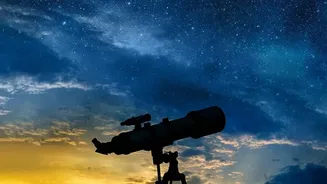
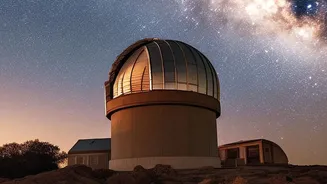
Long before it was a tourist destination, Hanle was a global hub for science. It is home to the Indian Astronomical Observatory (IAO), operated by the IIA since 2001. This high-altitude station hosts some of the world's most advanced telescopes, including the 2-metre Himalayan Chandra Telescope, used for optical, infrared, and gamma-ray observations. For scientists, the dark, unpolluted skies are not a luxury but a necessity. They allow for the observation of faint celestial objects, distant galaxies, and cosmic events that are completely invisible from light-polluted urban areas. The establishment of the Dark Sky Reserve formalises the protection of this crucial scientific asset, ensuring that India remains at the forefront of astronomical research.
Astro-Tourism and Local Life
The Hanle Dark Sky Reserve is a pioneering model of community-led conservation. Rather than shutting the area off, the initiative has empowered the local community, which traditionally relied on pastoralism. A key component is the training of local villagers as 'Astronomy Ambassadors'. Around 25 locals, many of whom are women, have been trained to operate telescopes, guide stargazing sessions, and share their knowledge with visitors. This has created a new, sustainable source of income, with the number of homestays growing to accommodate the influx of astro-tourists. Tourists pay a small fee for guided tours, and the economic benefits stay within the community, turning the night sky into a valuable asset that incentivises its own preservation.
Your Window to the Cosmos
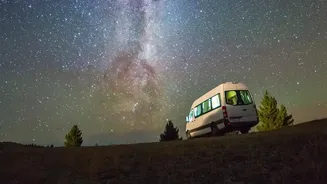
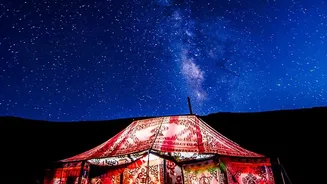
For the visitor, the experience is nothing short of profound. On a clear, moonless night, the Milky Way is not a faint band but a brilliant, textured river of light stretching across the sky, bright enough to cast a faint shadow. Planets like Jupiter and Saturn are easily visible, and meteor showers like the Perseids put on a spectacular display. But beyond the obvious, Hanle's pristine skies reveal rarer phenomena to the naked eye, such as the Zodiacal Light—a faint, ethereal glow caused by sunlight scattering off dust in the solar system. With the help of the local Astronomy Ambassadors and their telescopes, visitors can explore star clusters, nebulae, and even the faint glow of the Andromeda galaxy, our cosmic next-door neighbour.