





Nature’s Ultimate Sunscreen
Melanin is a remarkable biopolymer found throughout the natural world. It is the pigment that gives color to our skin, hair, and eyes, and its primary job is photoprotection—shielding organisms from the damaging effects of ultraviolet (UV) radiation.
But its capabilities go far beyond that. This natural material is incredibly effective at absorbing a wide spectrum of energy, from visible light to ionizing radiation, and converting it into harmless heat. This unique property has made it a subject of intense research, with scientists exploring everything from melanin-based cosmetics to materials that could protect astronauts from cosmic rays in space. The study of harnessing nature's designs to solve human challenges is known as biomimicry, and melanin is one of its most promising subjects.
The Problem with Sun-Soaked Solar Panels
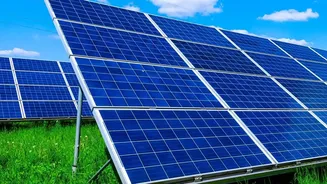
While solar panels are designed to sit in the sun, constant exposure to the elements, particularly intense UV radiation and extreme heat, gradually degrades their performance. The materials within photovoltaic cells break down over time, reducing their efficiency and shortening their operational lifespan. This is a significant challenge for solar farm operators, especially in sun-drenched regions like India, where high temperatures and relentless sun are the norm. Protecting these valuable assets is crucial for ensuring a stable and cost-effective supply of renewable energy. This has led researchers to look for innovative coatings that can act as a shield, preserving the integrity of the panels without blocking the sunlight they need to convert into electricity.
How a Squid Ink Coating Works
The idea is to create a thin, transparent layer using melanin extracted from a renewable source like squid ink. Researchers have been experimenting with methods to isolate melanin from the ink sacs of cephalopods and process it into a form that can be applied as a coating. When applied to a solar panel, this melanin layer would act as a dedicated filter. It absorbs the most damaging high-energy UV rays before they can reach and damage the delicate photovoltaic materials below. Simultaneously, its ability to manage thermal energy could help dissipate excess heat, preventing the panel from overheating and losing efficiency. Early research into using purified squid ink in dye-sensitized solar cells has already shown its potential to interact effectively with solar cell components.
From the Ocean to the Energy Grid
The research into melanin coatings is still in its early stages. Scientists are working to perfect methods for extracting and purifying natural melanin, as well as developing synthetic versions that mimic its properties. One research project is focused on adding a layer of melanin from Loligo duvaucelli, a type of squid, to solar panels and testing its ability to absorb UV radiation. While naturally produced melanin is seen as highly efficient, scaling up production for industrial applications remains a hurdle. Researchers are also exploring melanin from other sources, such as fungi that thrive in high-radiation environments like Chernobyl, for its protective qualities. The long-term goal is to develop a cost-effective and scalable manufacturing process that would allow melanin-based coatings to be widely adopted in the solar industry and beyond.