




The Challenge of Deep Space Navigation
When we navigate on Earth, we take our Global Positioning System (GPS) for granted. A network of satellites constantly tells our devices where we are. But around the Moon, there is no such system. For decades, spacecraft have relied almost entirely on a system of giant
radio antennas on Earth called the Deep Space Network (DSN) to figure out their position. This process is slow, resource-intensive, and creates a significant bottleneck. As more missions from different countries and private companies head to the Moon, the DSN is like a single highway for a rapidly growing city — it’s getting congested. Every manoeuvre, from orbit insertion to landing, has required constant communication with ground control, a cosmic conversation with a significant time delay.
A Landmark Achievement in Autonomy
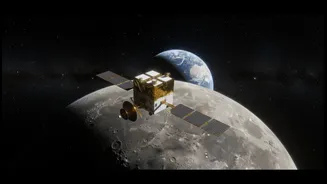
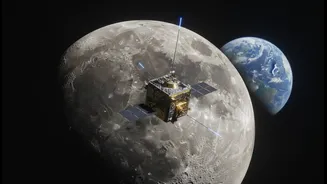
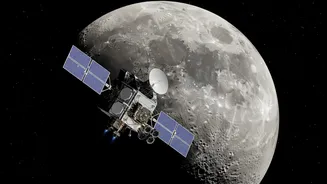
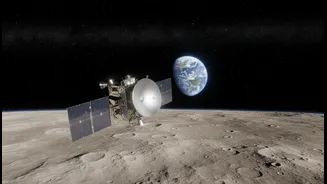
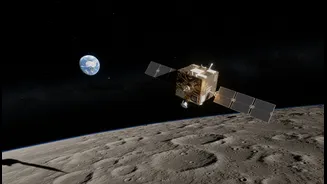
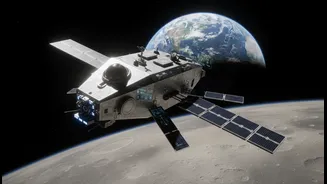
This is where a small, microwave-sized spacecraft named CAPSTONE has just made history. NASA recently confirmed that the Cislunar Autonomous Positioning System Technology Operations and Navigation Experiment (CAPSTONE) successfully completed its extended mission, which included a groundbreaking test. For the first time, a specialized software system called autonomous Navigation, Guidance, and Control (autoNGC) was tested at the Moon. This software effectively allowed the CAPSTONE spacecraft to determine its own position and trajectory without waiting for instructions from Earth. Essentially, it gave the spacecraft the ability to navigate on its own, a critical step towards true autonomy in deep space. The mission, owned and operated by the company Advanced Space, proved that spacecraft can become self-reliant in the complex gravitational environment between the Earth and Moon.
Why This Is a Game-Changer for Lunar Missions
The success of CAPSTONE's autonomous navigation test is more than just a technical achievement; it fundamentally changes the economics and logistics of lunar exploration. Spacecraft that can navigate independently will be more efficient, safer, and less reliant on the over-burdened DSN. This allows for more missions to operate simultaneously and opens the door for complex operations like rendezvous and docking in lunar orbit without micromanagement from Earth. This capability is essential for NASA's Artemis program, which aims to establish a sustained human presence on the Moon. It is particularly vital for the upcoming Gateway, a small space station planned for lunar orbit that will serve as a staging point for missions to the surface. The Gateway and other future lunar infrastructure will need to operate with a high degree of autonomy to be viable.
Implications for India’s Lunar Ambitions
While this milestone was achieved by a US mission, its implications are global, and particularly relevant for India's ambitious space program. The Indian Space Research Organisation (ISRO) has already demonstrated its incredible capabilities with the Chandrayaan missions. As ISRO plans for future lunar exploration, including potential crewed missions and more complex robotic landings, the development of sovereign autonomous navigation technology will be a strategic imperative. Relying on ground stations, whether domestic or international, presents limitations. Mastering autonomous systems, as demonstrated by CAPSTONE, would grant future Indian missions greater flexibility, reduce operational costs, and enhance mission success rates. This technological leap represents a new frontier in space exploration, and for a space-faring nation like India, it highlights a key area of technology to invest in and master for the next generation of lunar and interplanetary journeys.