



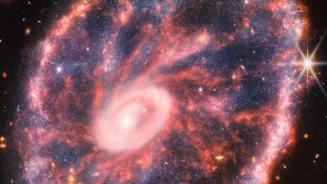
Meet the Roman Space Telescope
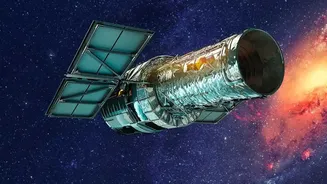
NASA's next flagship mission is the Nancy Grace Roman Space Telescope, named after the agency's first chief of astronomy. Scheduled to launch in the latter half of 2026, Roman is a premier space observatory on the same scale as the Hubble and James Webb
Space Telescopes. However, it comes with a game-changing new trick. While Hubble and Webb are like powerful zoom lenses, designed to stare deeply into small patches of sky, Roman is a panoramic photographer. Its Wide-Field Instrument (WFI) will have a field of view at least 100 times larger than Hubble's, allowing it to survey huge swathes of the cosmos with incredible speed and detail. Think of it as creating a grand, high-resolution map of the universe, rather than studying single, distant landmarks.
The Search for Hidden Galaxies
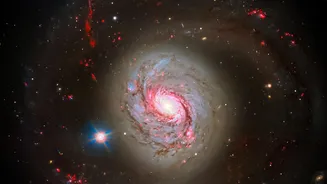
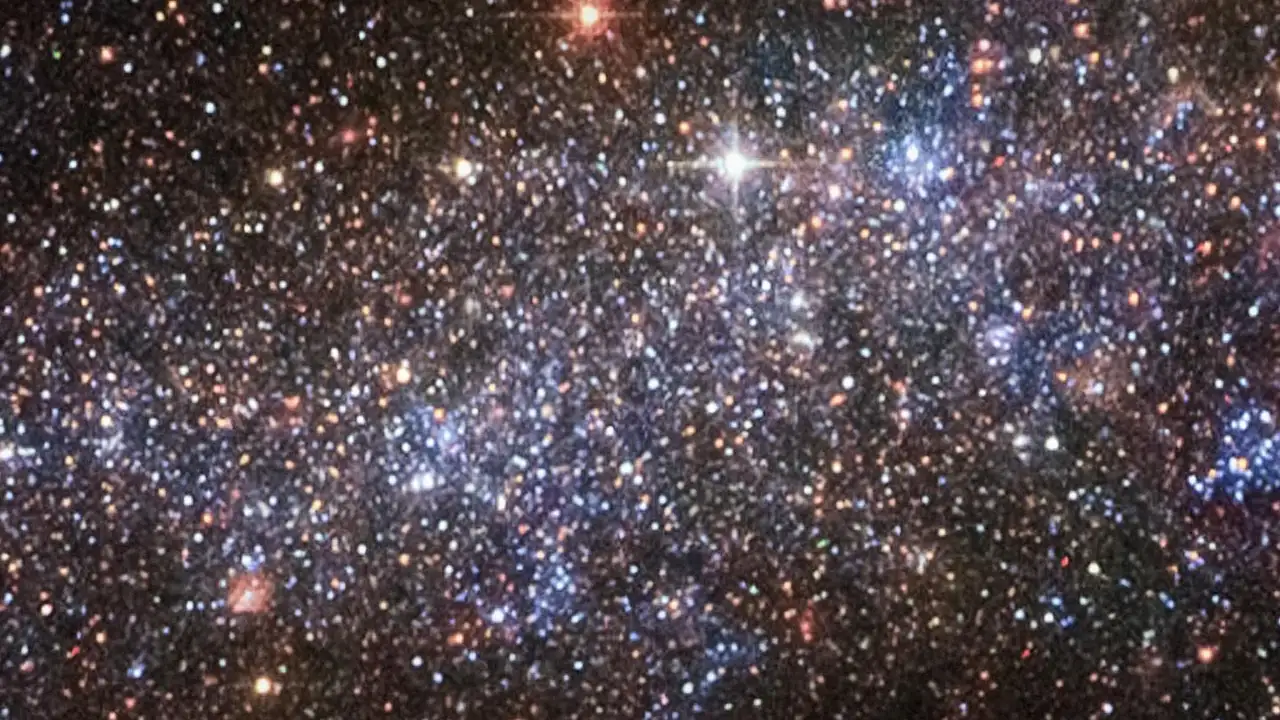
The headline-making promise of Roman is its potential to find millions of 'hidden' galaxies. These aren't galaxies hiding behind asteroids; they are celestial islands of stars that are incredibly faint and diffuse. Known as low-surface-brightness (LSB) galaxies, these objects are so spread out that their light is dimmer than the background glow of our own night sky, making them virtually invisible to most previous surveys. Specifically, astronomers are keen to find ultra-faint dwarf galaxies, which are thought to be the most common type of galaxy in the universe but have been incredibly difficult to spot. Finding these galaxies is crucial because they are believed to be dominated by dark matter and could hold the keys to understanding how all galaxies, including our own Milky Way, are formed and evolve.
How Roman Will Find Them
Roman’s power comes from its unique combination of a wide view, sharp resolution, and infrared sensitivity. By repeatedly imaging vast areas of the sky, it will build up data that allows astronomers to subtract the light from foreground stars and the sky's own glow, revealing the faint, ghostly structures hiding underneath. Its ability to see in infrared light is also critical, as it can peer through cosmic dust and capture the light from the most distant objects in the universe. By surveying thousands of square degrees of the sky, Roman is expected to increase the current sample of known dwarf galaxies by several orders of magnitude, providing a massive new dataset for studying the universe’s fundamental structure.
More Than Just a Galaxy Hunter
While mapping hidden galaxies is a major goal, Roman is a multi-purpose observatory with a broad scientific agenda. One of its other primary objectives is to solve the mystery of dark energy, the enigmatic force causing the universe's expansion to accelerate. It will do this by precisely measuring the distances to millions of galaxies and thousands of supernovae. Roman is also a powerful exoplanet hunter. Using a technique called gravitational microlensing, it is expected to discover thousands of new planets, from gas giants to smaller, rocky worlds, and even find rogue planets that drift through space without a host star. A sophisticated coronagraph instrument will also test new technology for directly imaging planets, paving the way for future missions like the Habitable Worlds Observatory.
The Next Chapter in Astronomy
The Nancy Grace Roman Space Telescope is currently scheduled for launch on August 30, 2026, aboard a SpaceX Falcon Heavy rocket. After launch, it will travel to an orbit about 1.5 million kilometers from Earth, a stable point in space where it can conduct its five-year primary mission. By working in tandem with other observatories like the James Webb Space Telescope—with Roman finding targets across its wide surveys and Webb performing deep, detailed follow-up observations—the mission is set to open a new window on the cosmos. It represents a major investment in our quest for knowledge, promising to fill in the missing pages of our cosmic history and likely reveal new mysteries we haven't even thought to ask about yet.