



The Old Problem: Heavy Fuel Tanks
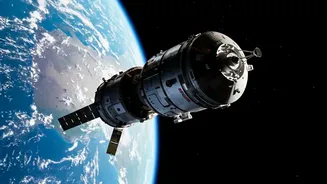
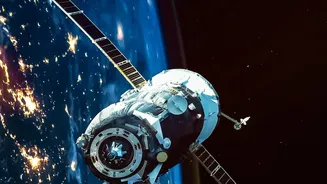
For decades, satellites have navigated space using chemical thrusters. These are essentially small, controlled rocket engines that burn propellant to produce bursts of force. This force is needed for everything from the initial journey to the final orbit
(orbit-raising) to the tiny adjustments needed to fight Earth's gravitational pull and stay in the correct position (station-keeping). The problem is that chemical propellants are inefficient. A satellite needs to carry a massive amount of this fuel, which can account for a huge portion of its launch weight. For a typical four or five-tonne communication satellite, the fuel alone can weigh over two tonnes. This not only makes the satellite heavy and expensive to launch but also puts a hard limit on its operational lifespan. Once the tank runs dry, the satellite, no matter how functional its electronics are, becomes space debris.
The New Solution: Electric Propulsion
Enter the plasma thruster, a form of electric propulsion (EP) that is revolutionising satellite design. Instead of a violent chemical reaction, plasma thrusters use electricity—typically generated by the satellite's solar panels—to create and accelerate a stream of electrically charged gas, or plasma. This technology is not about brute force. The thrust produced by a plasma engine is incredibly gentle, often compared to the force of a single sheet of paper resting on your hand. However, what it lacks in power, it makes up for in extraordinary efficiency. While a chemical thruster provides strong, short bursts, a plasma thruster provides a continuous, gentle push that, over weeks or months, achieves the same results with a tiny fraction of the fuel. This fundamental shift from high thrust to high efficiency is the key to its advantage.
How Plasma Thrusters Work
One of the most common types of plasma thrusters used by ISRO and other agencies is the Hall-effect thruster. It works by injecting a small amount of an inert gas, usually xenon, into a ceramic-lined chamber. Here, a magnetic field traps electrons, which are energized by an electric field. These high-energy electrons collide with the xenon atoms, stripping them of their own electrons and turning them into positively charged ions—creating a plasma. An electric field then accelerates these heavier positive ions out of the chamber at incredibly high speeds, up to 30 kilometres per second. This high-speed exhaust generates a gentle but constant thrust that pushes the satellite forward. Because it uses electromagnetic forces to accelerate the propellant, it achieves a much higher 'specific impulse'—a measure of fuel efficiency—that is five to six times better than chemical rockets.
The ISRO Advantage: Lighter and Longer-Lasting
By adopting plasma thrusters, ISRO can dramatically reduce the mass of its satellites. For example, a communication satellite that would traditionally need 2,500 kg of chemical fuel can now perform the same mission with only about 200 kg of xenon propellant. This massive weight reduction has two major benefits. First, it extends the satellite's operational life. With fuel consumption for station-keeping drastically reduced, a mission designed for 15 years can potentially last much longer. Second, the weight saved on fuel can be reallocated to the satellite’s primary purpose: its payload. This means ISRO can pack more transponders onto a communication satellite or more advanced sensors onto an earth observation satellite, increasing its capability and the return on investment for each launch.
A Strategic Shift for India's Space Program
ISRO has been progressively integrating this technology. The GSAT-9 satellite, launched in 2017, was an early demonstrator, using an imported thruster for some in-orbit functions. More recently, the focus has shifted to fully indigenous systems. ISRO has developed and tested its own stationary plasma thrusters, including a 300 mN thruster designed for upcoming missions like the Technology Demonstrator Satellite (TDS-01). While the low thrust means it takes longer to raise a satellite to its final geostationary orbit—months instead of a week—the long-term benefits are undeniable. This technology allows a lighter two-tonne satellite to perform the job of a four-tonne one, potentially enabling launches on smaller, less expensive rockets and paving the way for more ambitious, cost-effective Indian space exploration in the future.