
In a remarkable display of international cooperation, India’s Aditya-L1 solar mission is teaming up with the European Space Agency’s Proba-3 to get an unprecedented look at the Sun’s most violent outbursts. This cosmic partnership promises to unlock secrets
about solar eruptions.
Meet the Celestial Detectives
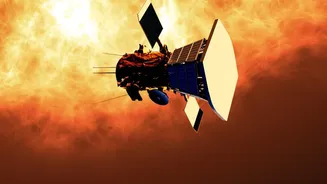
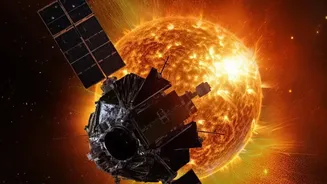
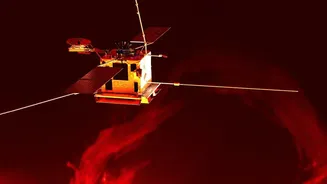
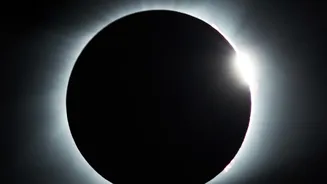
At the heart of this collaboration are two highly specialised missions. India's Aditya-L1, launched by ISRO in September 2023, is the nation's first dedicated solar observatory. From its strategic vantage point at Lagrange point 1 (L1), about 1.5 million kilometres from Earth, it has an uninterrupted view of the Sun. Its key instrument, the Visible Emission Line Coronagraph (VELC), developed by the Indian Institute of Astrophysics, is designed to study the solar corona, the Sun's mysterious and superheated outer atmosphere. Its counterpart is the European Space Agency’s (ESA) Proba-3, a groundbreaking mission launched in December 2024, interestingly, aboard an Indian PSLV rocket. Proba-3 is the world's first precision formation-flying mission, consisting of two spacecraft flying in a tight, stable formation about 150 meters apart. This unique setup allows one spacecraft to block the Sun's bright face, creating a prolonged artificial eclipse for the other to observe the faint inner corona with unmatched clarity.
The Sun's Mysterious Outbursts
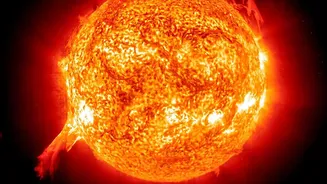
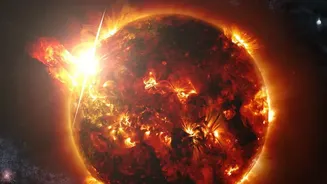
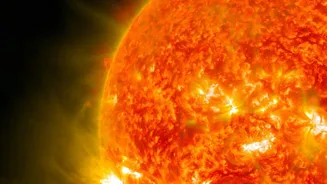
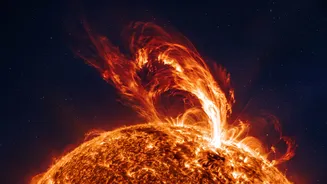
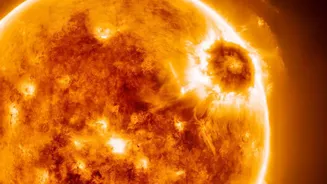
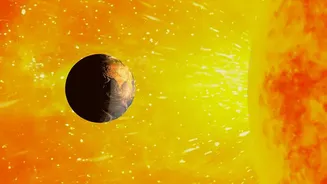
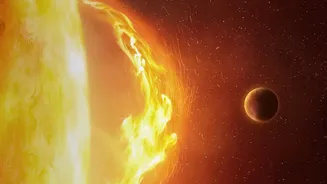
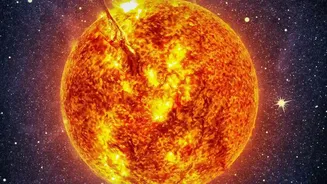
The Sun may appear serene from Earth, but it frequently unleashes colossal explosions of plasma and magnetic fields known as Coronal Mass Ejections (CMEs). These solar storms hurl billions of tonnes of charged particles into space. When directed at Earth, they can trigger powerful geomagnetic storms that pose a significant threat to our modern, technology-dependent civilisation. CMEs can disrupt satellite operations, scramble communication and GPS navigation systems, and even damage terrestrial power grids. To better predict and mitigate these 'space weather' events, scientists need to understand how they originate and evolve in the moments after they erupt from the Sun. However, observing the faint, tenuous corona where CMEs are born is incredibly difficult, as the region is usually blinded by the Sun's own brilliant light.
A Cosmic Partnership Perfected
This is where the genius of the India-Europe collaboration comes into play. Aditya-L1 and Proba-3 have complementary capabilities that, when combined, provide a more complete picture than either could alone. Proba-3's ASPIICS coronagraph uses its artificial eclipse to capture crisp, white light images of the inner corona, revealing the shape, mass, and dynamics of a CME as it first erupts. It essentially sees the eruption happen. Simultaneously, Aditya-L1's VELC instrument performs spectroscopy, analysing the light from the eruption to measure properties like the temperature, density, and velocity of the ejected plasma along the line of sight. In a recent joint analysis of two CMEs observed in September 2025, scientists were able to crosscheck their data, achieving a more robust understanding of the eruptions' energy and composition right from their birth.
Why Two Views Are Better Than One
By combining the 'what' from Proba_3's images with the 'how' from Aditya_L1's spectroscopic data, scientists can build a three_dimensional model of a solar eruption from a single vantage point. This is a major leap forward from past methods, which often assumed CMEs expanded as simple, symmetric bubbles. The joint observations have revealed that these eruptions can be asymmetric and expand unevenly, which has significant implications for how they travel through space and how fast they might reach Earth. The collaboration allows for independent estimates and cross_verification of key CME parameters, reducing uncertainties and building more accurate models for space weather forecasting. The study, published in the journal 'Astronomy & Astrophysics', marks the first time data from these two missions have been jointly analysed, showcasing the power of this new observational strategy.
India's Place in the Sun
This partnership is more than just a scientific success; it signifies India's growing stature as a major player in global space exploration. ISRO is not merely a launch provider for ESA's Proba_3 but an active and equal scientific partner. The collaboration, spearheaded by researchers at the Indian Institute of Astrophysics in Bengaluru, demonstrates India's capability to develop world_class scientific instruments and contribute vital data to cutting_edge research. The long_term cooperation agreement between ISRO and ESA, recently extended until 2032, covers a wide range of activities from human spaceflight to Earth observation, fostering a stable framework for future joint projects. This 'cosmic handshake' over the Sun reinforces the value of international cooperation in tackling the biggest questions in science and protecting our shared technological infrastructure.